Climate

Courses tagged with "Climate"

MLWC MOOC 3: Applications of Machine Learning in Weather and Climate

Six modules giving ML applications in observations, forecasting, data assimilation, post-processing, ocean and more.

Certification course: No
What you'll learn:

  • The application of ML methods to a range of problems in weather and climate
  • The details of practical code examples which can be used to apply to your own problems
Prerequisites:

Please complete MOOC MLWC - 2. Concepts of Machine Learning first, or ensure you are familiar with the topics covered there. Intermediate proficiency with Python, knowledge of statistics and experience in weather/climate is assumed.

Full description:

In this third tier of our MOOC on Machine Learning (ML) in Weather and Climate, we focus on the implementation of ML in weather and climate problems.

This six-module course gives code examples and explainers in topics including:

  • Satellite precipitation removal
  • Environmental modelling
  • Nowcasting
  • Data assimilation
  • Downscaling
  • Ocean modelling
  • Operational meteorology

This course is aimed at those with a technical/weather background and experience in Python. Ideally you will have already taken Tiers 1 and 2 of the MOOC on ML in Weather and Climate, or already be familiar with the concepts there. 

Please note that this course ran live in early 2023 and reflected the state of the art at that point in time.

Estimated duration: 25 hours
Hide last updated info: No
Hide number of enrollments: No
Hide full description label: No
Atmospheric composition: No
Climate: Yes
Computing services and tools: No
Data applications: No
Forecasting: No
Machine learning: No
Numerical weather prediction: No

MLWC MOOC 2: Concepts of Machine Learning in Weather and Climate

Five modules covering decision trees, deep learning, uncertainty and generative models, and physics-guided approaches.

Level: Fundamentals
Certification course: No
What you'll learn:

  • The main concepts of data retrieval using CliMetLab
  • Theory and application of regression and decision trees
  • Theory underlying deep neural networks, and software tools to apply them to practical problems
  • Uncertainty quantification using Bayesian and generative approaches
  • Physics-constrained approaches

By the end of this course, participants should have a sound understanding of the theory underpinning key ML approaches, and how these can be applied in practice.

Prerequisites:

Please complete MOOC MLWC - 1. ML in Weather & Climate first, or ensure you are familiar with the topics covered there. Basic proficiency with Python, knowledge of statistics and experience in weather/climate is assumed.

Full description:

In this second tier of our MOOC on Machine Learning (ML) in Weather and Climate, we go deeper into the theory underpinning ML, and the tools that are used to implement it, using Python case studies in weather and climate.

This five-module course covers regression trees and random forests, explores workflows in ML, and dives deeper into the ingredients of deep neural networks, including architectures, training, tuning and evaluating models. We will also explore approaches to quantify uncertainty, including generative ML models and Bayesian neural networks. The last module covers physics-guided ML approaches with applications to post-processing.

This course is aimed at those with a technical/weather background, some experience in Python, and a solid understanding of statistics. Ideally you will have already taken Tier 1 of this MOOC or already be familiar with the concepts there. 

This course features a mixture of interactive modules, webinar recordings, quizzes, podcasts, and contains a number of detailed code examples.

Please note that this course ran live in early 2023 and reflected the state of the art at that point in time.

Estimated duration: 14 hours
Hide last updated info: No
Hide number of enrollments: No
Hide full description label: No
Atmospheric composition: No
Climate: Yes
Computing services and tools: No
Data applications: No
Forecasting: No
Machine learning: No
Numerical weather prediction: No

MLWC MOOC 1: Introduction to Machine Learning in Weather and Climate

Six modules introducing the main topics in machine learning in the context of weather and climate.

Level: Fundamentals
Certification course: No
What you'll learn:

  • An overview of machine learning in weather and climate
  • Unpack, at a conceptual level, key concepts and topics in ML
  • Applications and recent advances in the field
Prerequisites:

A basic knowledge of weather and climate, statistics and computing.

Full description:

In this first tier of our MOOC on Machine Learning (ML) in Weather and Climate, we give a broad overview of the key concepts ML and its applications in recent years to topics from forecasting and data assimilation to post-processing, observations and computing. This course is aimed as an introduction, which is accessible to those with an interest in ML, weather and climate, but without necessarily requiring a very technical background.

This course features a mixture of interactive modules, webinar recordings, quizzes, podcasts and code examples.

Please note that this course ran live in early 2023 and reflected the state of the art at that point in time.

Estimated duration: 14 hours
Hide last updated info: No
Hide number of enrollments: No
Hide full description label: No
Atmospheric composition: No
Climate: Yes
Computing services and tools: Yes
Data applications: No
Forecasting: No
Machine learning: No
Numerical weather prediction: No

Understanding Climate Data

From analysis of the past to future projections

Short online course
Because you don't have to be a climate scientist to make climate data work for you!

February 2026
Online, self-paced
8 hours

Level: Fundamentals
Certification course: Yes
Full description:

Overview

Do you want to learn to use climate data and information in your work with confidence, even though you don't have a background in climate data science? Then this course is for you!

Climate change is no longer a distant concern — it is shaping the decisions we make today. Rising temperatures, shifting rainfall, sea level rise, and more frequent extreme events affect water management, infrastructure, health, food systems, and economies worldwide.

image1 So whether you are a researcher, advisor, policymaker, extension worker or educator - whether you work in finance, insurance, urban planning, renewable energy, or any other sector, it is likely that climate change is a factor you have to take into account.

The Copernicus Climate Change Service (C3S) provides reliable, consistent and authoritative information about climate change that is freely accessible - and with its user-friendly tools and services, C3S has made quality climate data easy to use.

To help professionals around the world find, interpret and confidently use C3S climate data and information in their work, C3S is launching 3 online short courses in 2026 that provide learners with the necessary knowledge and skills to use climate data.

Using climate data starts with understanding what climate data are, how they are produced, what different types of climate data are available to you, what these can and cannot be used for, and where you can find the data you need.

Understanding climate data doesn’t mean having to become a climate scientist, but you do need to understand the basics to make the right choices for your needs.

Join our first online short course to understand the basics of climate data and gain the confidence to find, interpret, and use the right information in your own work.

Enrollment Start Date: 18 December
Enrollment End Date: 20 March
Course Start Date: 23 February
Course End Date: 30 April


The course is the first in a sequence of 3 online courses on climate data offered by C3S. The courses build upon each other. With the foundational knowledge you gain in this first course, you will get the necessary building blocks for advancing and deepening your knowledge and skills in the subsequent courses.

MOOC visual

Objectives of the training

This course introduces the foundations of climate data: what it is, how it is collected, processed, and made available by C3S. It enables you to make sense of the climate data types provided by C3S, understand their scope of use and limitations. It provides an overview of the C3S Climate Data Store (CDS) and other tools and services offered by C3S. Climate data types covered in this course include observations, reanalysis, seasonal predictions, and climate projections, with derived indicators covered in the next MOOC in the series.

After this course you will be able to:
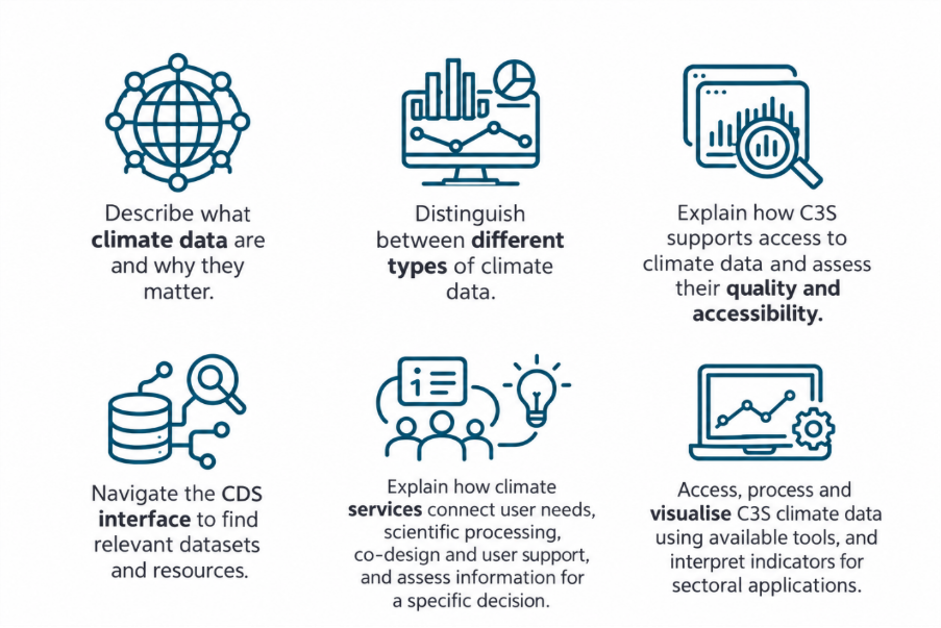
objectives of the MOOC

By the end of this course, you will be able to navigate the world of climate data and apply it confidently in your field.

Target audience

This course is for anyone who needs or wants to (better) understand climate data but does not have necessary knowledge yet to make sense of different climate data types: what they can and cannot be used for, who uses these data types, and where you may find the climate data that fits your needs.

Example learners for whom this course was created:


target audience

No expertise in the domain of climate data is needed to follow this course.


Course structure and content

The course is fully online and self-paced, meaning that you may go through the content in your own time. Study load for the course amounts to a total of approximately 8 study hours in total. The course is open for the limited duration of 8 weeks.

It consists of six modules, with the first covering the foundations of climate data and introducing the five climate data types that will be explored in the subsequent modules: observations, models, reanalysis, predictions, and projections.

modules timeline


Each module has a variety of learning activities and real-life examples that allow you to get a solid understanding of the basics of climate data and enable you to explore the C3S data sets. In each module you will meet a professional with a climate data need for a particular purpose. These cases illustrate the use of climate data in practice. Other learning content includes videos, images, text, podcasts, quizzes and discussion questions.

user - renewable energy

Course contributors

MOOC Banner

This course was created by ECMWF through C3S and contracted to Wageningen University & Research (WUR). Input to the course was also provided by experts from academia, national meteorological services and private industry.


Hide last updated info: Yes
Hide number of enrollments: Yes
Hide full description label: Yes
Atmospheric composition: No
Climate: No
Computing services and tools: No
Data applications: No
Forecasting: No
Machine learning: No
Numerical weather prediction: No
Category: Climate

Climate Projections

About climate projections, differences between climate models, and how to choose from climate projection data.

Level: Fundamentals
Certification course: No
What you'll learn:

  • What climate projections are
  • How to choose climate models
  • Where to find climate projections in the Climate Data Store
  • How to choose climate projection data
Hide last updated info: No
Hide number of enrollments: No
Hide full description label: No
Atmospheric composition: No
Climate: No
Computing services and tools: No
Data applications: No
Forecasting: No
Machine learning: No
Numerical weather prediction: No
Category: Climate

Bias Correction and Downscaling

This lesson teaches about downscaling and bias correction methods. An exercise for bias correction is included.

Level: Fundamentals
Certification course: No
What you'll learn:

  • About biases in climate models
  • The principles of bias correction and downscaling
  • A simple bias correction exercise
Hide last updated info: No
Hide number of enrollments: No
Hide full description label: No
Atmospheric composition: No
Climate: No
Computing services and tools: No
Data applications: No
Forecasting: No
Machine learning: No
Numerical weather prediction: No
Category: Climate

Climate Data Discovery – Introduction

An introduction to the different sources of climate data and how to find them.

Level: Fundamentals
Certification course: No
What you'll learn:

  • The difference between weather and climate
  • Different sources of climate data, including observations, renalysis, model forecasts and sectoral products
  • How to find the data you need
Hide last updated info: No
Hide number of enrollments: No
Hide full description label: No
Atmospheric composition: No
Climate: No
Computing services and tools: No
Data applications: No
Forecasting: No
Machine learning: No
Numerical weather prediction: No
Category: Climate

Climate Data Discovery – Advanced

Learn about the various data sources, and strategies to find climate data: processing, choosing projections, scenarios, ensembles and variables.

Level: Others
Certification course: No
What you'll learn:

  • An overview of the climate data processing chain
  • Scenarios used in CMIP5 and CMIP6
  • Strategies for selecting climate models
  • Downscaling techniques
  • The importance of skill assessment
  • How Sectoral Information Systems provide climate data tailored to your needs
  • Similarities and differences between processing climate projections, and seasonal climate predictions.
Full description:

This lesson provides details on the various data sources, and strategies to find the data needed: Processing steps, choosing projections, scenarios, ensembles, variables etc. The lesson is a follow-up of “Climate Data Discovery – Introduction”.

Hide last updated info: No
Hide number of enrollments: No
Hide full description label: No
Atmospheric composition: No
Climate: No
Computing services and tools: No
Data applications: No
Forecasting: No
Machine learning: No
Numerical weather prediction: No
Category: Climate

Data Resources - Climate Models

Uncover how climate models work and how they can be evaluated. Differences between climate projections, predictions and scenarios are explained.

Level: Fundamentals
Certification course: No
What you'll learn:

  • About the different types climate model and how they work
  • Differences between climate projections, predictions and scenarios
  • Evaluating climate models
  • What are climate ensembles?
  • The use of climate model data
Hide last updated info: No
Hide number of enrollments: No
Hide full description label: No
Atmospheric composition: No
Climate: No
Computing services and tools: No
Data applications: No
Forecasting: No
Machine learning: No
Numerical weather prediction: No
Category: Climate

Data Resources - Introduction

Learn about Essential Climate Variables, the different types of climate data resources, and their respective pros and cons.

Level: Fundamentals
Certification course: No
What you'll learn:

  • What Essential Climate Variables (ECVs) are
  • Types of climate data resources, including observations and models
  • Pros and cons of different data sources
Hide last updated info: No
Hide number of enrollments: No
Hide full description label: No
Atmospheric composition: No
Climate: No
Computing services and tools: No
Data applications: No
Forecasting: No
Machine learning: No
Numerical weather prediction: No
Category: Climate

Data Resources - Reanalyses

This lesson teaches users the basics of climate reanalysis. The lesson explains how reanalyses are made, an overview of global reanalyses datasets, and their strengths and limitations.

Level: Fundamentals
Certification course: No
What you'll learn:

  • What reanalysis is and how reanalyses are made
  • An overview of global reanalysis datasets
  • About ECMWF's ERA5 reanalysis data set and its strengths and weaknesses
Hide last updated info: No
Hide number of enrollments: No
Hide full description label: No
Atmospheric composition: No
Climate: No
Computing services and tools: No
Data applications: No
Forecasting: No
Machine learning: No
Numerical weather prediction: No
Category: Climate

Data Resources - Observations

Explore the different types of measurements, the types of observing systems and their measurement uncertainty.

Level: Fundamentals
Certification course: No
What you'll learn:

  • Which different types of measurements exist, including direct and indirect observations
  • The various meteorological observing systems (remote sensing, land, sea, air, etc) and their representativeness
  • How to account for uncertainties and propagate errors
Hide last updated info: No
Hide number of enrollments: No
Hide full description label: No
Atmospheric composition: No
Climate: No
Computing services and tools: No
Data applications: No
Forecasting: No
Machine learning: No
Numerical weather prediction: No
Category: Climate

Uncertainty, Robustness and Confidence

This lesson teaches about sources of uncertainty in climate projections, what robust signals are, and when we can be confident in a change.

Level: Others
Certification course: No
What you'll learn:

  • The differences between uncertainty, robustness and confidence
  • How model data can be used to define robust messages
  • When you can be confident about a climate change signal and when not
Hide last updated info: No
Hide number of enrollments: No
Hide full description label: No
Atmospheric composition: No
Climate: No
Computing services and tools: No
Data applications: No
Forecasting: No
Machine learning: No
Numerical weather prediction: No
Category: Climate

Using climate models for climate scenarios

This lesson teaches how to use climate models in the development of national climate scenarios. Examples are provided for The Netherlands, Switzerland and the U.K.

Level: Fundamentals
Certification course: Yes
What you'll learn:

  • What climate change scenarios are and why we use them
  • How IPCC climate scenarios are developed
  • About national climate scenarios and why they exist
  • Steps for developing national, regional and local climate scenarios
Hide last updated info: No
Hide number of enrollments: No
Hide full description label: No
Atmospheric composition: No
Climate: No
Computing services and tools: No
Data applications: No
Forecasting: No
Machine learning: No
Numerical weather prediction: No
Category: Climate
