
COMING UP IN JANUARY 2027: a facilitated live run with two additional modules
Online, self-paced, 18-20 hours with flexible learning within the facilitated course schedule.
Registration will open soon. Further details, including the course schedule and registration link, will be announced on this page on 1st of November.
Whether you are joining for the first time, returning to complete the course, or have already completed the six modules and want to expand your skills, we look forward to welcoming you.
Overview
Do you want to learn to use climate data and information in your work with confidence, even though you don't have a background in climate data science? Then this course is for you!
Climate change is no longer a distant concern — it is shaping the decisions we make today. Rising temperatures, shifting rainfall, sea level rise, and more frequent extreme events affect water management, infrastructure, health, food systems, and economies worldwide.
 So whether you are a researcher, advisor, policymaker, extension worker
or educator - whether you work in finance, insurance, urban planning,
renewable energy, or any other sector, it is likely that climate change
is a factor you have to take into account.
The Copernicus Climate Change Service (C3S) provides reliable, consistent and authoritative information about climate change that is freely accessible - and with its user-friendly tools and services, C3S has made quality climate data easy to use.
Using climate data starts with understanding what climate data are, how they are produced, what different types of climate data are available to you, what these can and cannot be used for, and where you can find the data you need.
Understanding climate data doesn’t mean having to become a climate scientist, but you do need to understand the basics to make the right choices for your needs.
Join our first online short course to understand the basics of climate data and gain the confidence to find, interpret, and use the right information in your own work.
To help professionals around the world find, interpret and confidently use C3S climate data and information in their work, C3S launched an open online course in 2026 that provided learners with the necessary knowledge and skills to use climate data.
An expanded version of this course with a new facilitated live run is coming up in January 2027. It will consist of eight modules on climate data offered by C3S. The modules are designed to build progressively upon each other. The foundational knowledge gained in the first six modules provides the basis for developing more advanced knowledge and skills in the two new modules, which focus on sectoral applications and climate data and climate information handling.

Objectives of the training
This course introduces the foundations of climate data: what it is, how it is collected, processed, and made available by C3S. It enables you to make sense of the climate data types provided by C3S, understand their scope of use and limitations, and explore how climate data can be transformed into actionable information through climate services to support decision-making. It provides an overview of the C3S Climate Data Store (CDS) and other tools and services offered by C3S. Climate data types covered in this course include observations, reanalysis, seasonal predictions, and climate projections, with derived indicators.
After this course you will be able to:
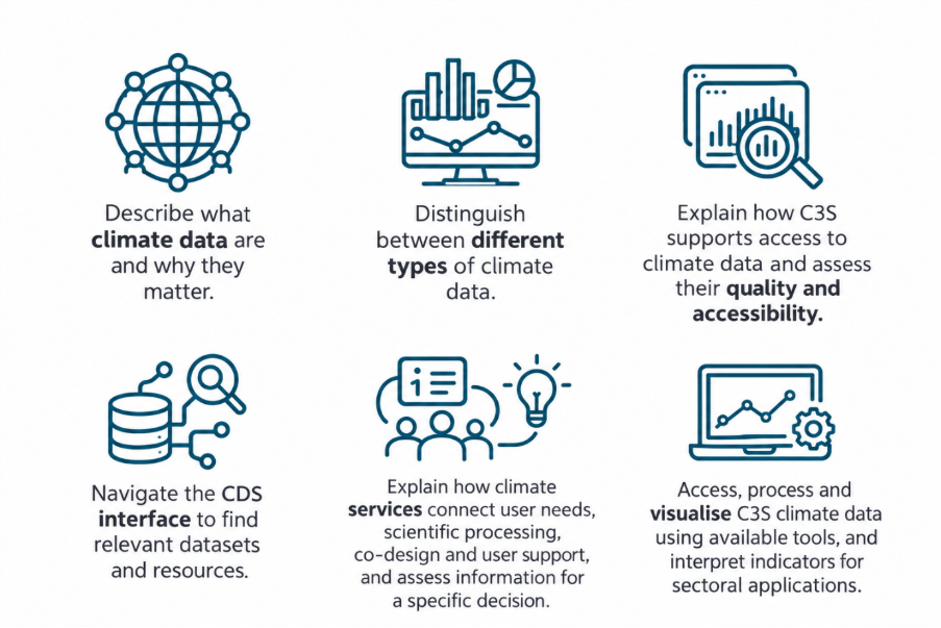
By the end of this course, you will be able to navigate the world of climate data and apply it confidently in your field.
Target audience
This course is for anyone who needs or wants to (better) understand climate data but does not have necessary knowledge yet to make sense of different climate data types: what they can and cannot be used for, who uses these data types, and where you may find the climate data that fits your needs.
Example learners for whom this course was created:

No expertise in the domain of climate data is needed to follow this course.
Course structure and content
The course is fully online, you will be able to work through the learning activities at your own pace within the course schedule.
The expanded course will consist of eight modules. The first six introduce the foundations of climate data: including observations, models, reanalysis, predictions, seasonal predictions and climate projections. Two additional modules build on these foundations, focusing on sectoral applications and climate data handling.


Each module has a variety of learning activities and real-life examples that allow you to get a solid understanding of the basics of climate data and enable you to explore the C3S data sets. In each module you will meet a professional with a climate data need for a particular purpose. These cases illustrate the use of climate data in practice. Other learning content includes videos, images, text, podcasts, quizzes, and discussion questions.

Course contributors

This course was created by ECMWF through C3S and contracted to Wageningen University & Research (WUR). Input to the course was also provided by experts from academia, national meteorological services and private industry.


Course Content
- Discussion Forum
- Certificate of completion
- 1.1 Welcome to this course
- 1.2 Introduction to Module 1: Setting the stage
- 1.3 Introduction to observations
- 1.4 Key sources of model output data
- 1.5 The Climate Data Store (CDS)
- 1.6 Closure of Module 1
- 2.1 Introducing observations
- 2.2 Climate Data Records
- 2.3 Observation data from C3S
- 2.4 Closure of Module 2
- 3.1 Introducing climate models
- 3.2 Characteristics of a climate model
- 3.3 Evaluating climate models
- 3.4 Climate model derived data in the CDS
- 3.5 Closure of Module 3
- 4.1 What is reanalysis?
- 4.2 Evolution of reanalysis
- 4.3 Reanalysis datasets in the CDS
- 4.4 Closure of Module 4
- 5.1 Introducing climate predictions
- 5.2 Predictions at different time horizons
- 5.3 Skill assessment
- 5.4 Closure of Module 5
- 6.1 Introducing climate projections
- 6.2 Downscaling
- 6.3 Closure of Module 6