
Overview
Discover how machine learning is being applied to real-world Earth system challenges and explore the emerging approaches shaping the future of weather and climate modelling. Under the Destination Earth (DestinE) initiative of the European Commission (DG Connect), ECMWF has developed a series of three online courses on Machine Learning for Earth Systems Modelling.
The courses offer a structured learning pathway, from foundations and context (Course 1) to advanced architectures (Course 2) and real-world applications (Course 3), showing how machine learning (ML) complements physical modelling and supports next-generation digital twins of the Earth.
This third and final course of the series, Machine Learning for Earth Systems Modelling: Applications and Future Directions, focuses on advanced applications of ML across weather, climate, and Earth Systems Science. Participants will explore how ML methods can be applied to extreme events, explainability and trust, foundation and hybrid models, sub-seasonal and long-range prediction, downscaling, coupled Earth systems, data assimilation, and end-to-end forecasting workflows.
With a strong hands-on emphasis, the course combines expert lectures and talks with Jupyter notebooks, readings, panel discussions and quizzes. It is designed both as the final step in the three-course learning pathway and as a collection of standalone advanced modules for experienced practitioners.
Course information and registration
Estimated study load: Approximately 16-24 hours
Format: Online, self-paced, primarily asynchronous, with a strong hands-on component
Participation: Free and open to anyone interested who meets the recommended prerequisites
If you are interested in taking the course, you can already register your interest by logging in and enrolling at the bottom of this page.
Objectives
By the end of this online course, Machine Learning for Earth Systems Modelling: Applications and Future Directions, you will have developed the knowledge and skills outlined in the learning outcomes below.
-
Implement ML workflows for real world Earth system applications
-
Evaluate the operational readiness, and limitations of ML based systems
-
Understand foundation and hybrid modelling strategies for Earth system science
-
Diagnose failure modes and instability in ML based forecasts
-
Apply ML approaches to downscaling, data assimilation, coupling, and long-range prediction
-
Critically assess emerging research directions in ML for weather, climate, and Earth system modelling
Target audience
This course is the third and final course in the three-part DestinE online training series on Machine Learning for Earth Systems Modelling.
Course 3 - Applications and Future Directions is an advanced technical course aimed primarily at:
-
Researchers and developers in weather, climate, and Earth-system science
-
Operational numerical weather prediction (NWP) and climate model developers
-
ML researchers working with environmental or geophysical data
-
Advanced PhD students and postdoctoral researchers
The course can be followed as the final step in the complete three-course programme or as standalone advanced modules by experienced practitioners with the required technical background.
Prerequisites
Participants are expected to have:
-
Familiarity with Python and Python-based ML ecosystems
-
Experience with NumPy/xarray and PyTorch or JAX
-
An understanding of the fundamentals of numerical weather prediction and Earth system modelling
-
Knowledge of core ML methods covered in Courses 1 and 2
Prior completion of Course 1 – Foundations and New Frontiers and Course 2 – Architectures, Data and Prediction is recommended for learners who do not already have equivalent knowledge and experience.
Course structure and content
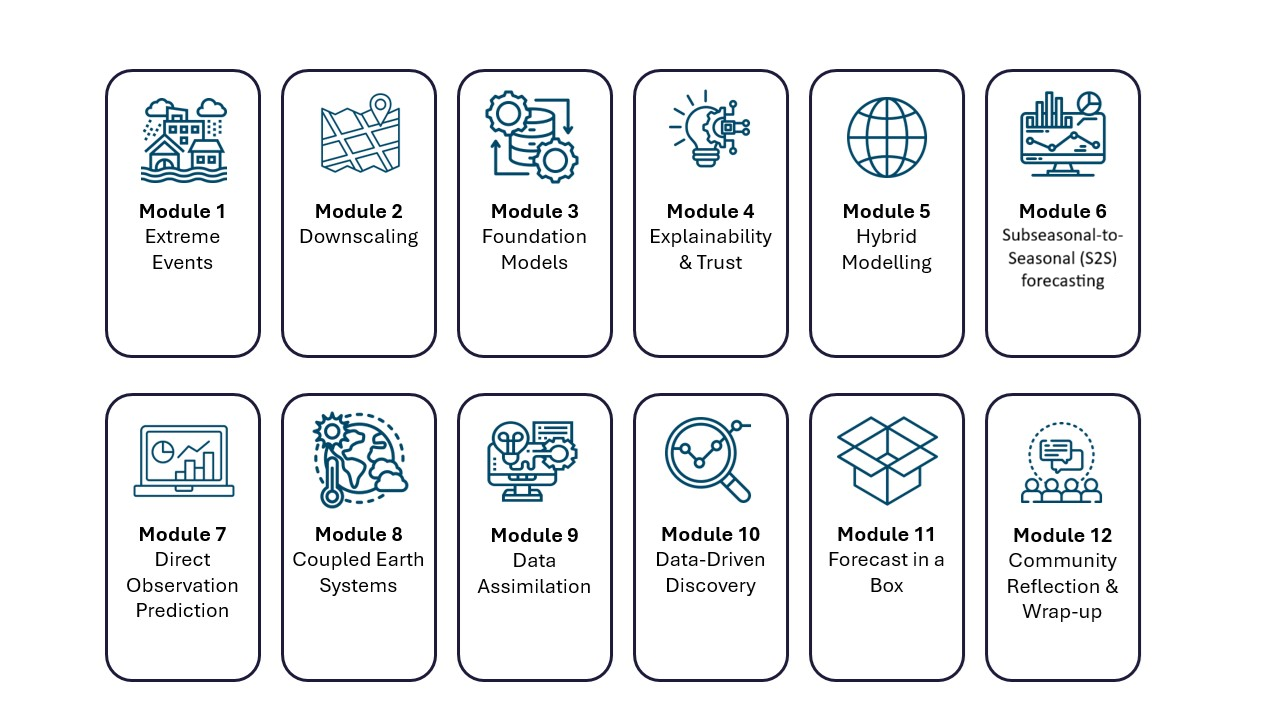
The course consists of 12 modules covering advanced applications and emerging directions in machine learning for Earth-system modelling. The modules move from applied ML workflows for extreme events to explainability, foundation and hybrid models, long-range prediction, downscaling, coupled Earth systems, ML-based data assimilation, end-to-end modelling, operational forecasting workflows, and data-driven scientific discovery.
The course has a strong practical emphasis. Learning materials include recorded lectures and expert talks, Jupyter notebooks using real-world workflows, Python scripts, demonstrations, readings, quizzes, reflective activities, and expert discussions.
The modules are:
Course lecturers and contributors
This course was created by ECMWF under the Destination Earth (DestinE) initiative of the European Commission’s DG Connect and contracted to Wageningen University (WU), in collaboration with the Karlsruhe Institute of Technology (KIT) and Wageningen Research (WR). Scientific content is provided by experts from ECMWF, academia, research institutes, meteorological organisations, and industry.
Contributors are involved in topics ranging from extreme-event applications and explainable AI to foundation models, hybrid modelling, long-range prediction, downscaling, coupled Earth systems, data assimilation, end-to-end forecasting, and data-driven discovery.
More detailed descriptions of the course lecturers and contributors can be found here.
Experts include:
Lecturers
Eduardo Acuna Espinoza
Mihai Alexe
Tom Beucler
Niklas Boers

Eulalie Boucher

Harrison Cook

Jesper Dramsch

Joffrey Dumont

Sebastian Engelke

Veronika Eyring

Marco Froelich

Rachel Furner
Saranya Ganesh Sudheesh
Alan Geer
William Gregory
Arthur Grundner
Tijana Janjic
Katie Kowal

Peter Lean
Claire Monteleoni

Carolina Natel

Ewan Pinnington

Ana Prieto Nemesio

Nina Raoult
Mario Santa Cruz
Julien Savre-Piou

Frederick Tam

Richard Turner

Lorenzo Zampieri
Course development and delivery

Samuel Sutanto
Dwaipayan Chatterjee

Imme Benedict
Janine Quist
Vassianna Alexopoulou
Martin Janssens
Course coordination

Natalia Gomez-Solano

Olga Loegel
Jona Wong Chung
Course Content
- Please fill in this pre-course survey
- Announcements
- Forum
- Course contributors
- Welcome to this course
- 1.1 Extreme event prediction with AI weather models: Abilities and limitations
- 1.2 Flood forecasting using ML
- 1.3 Wildfire forecasting using ML
- 1.4 Quiz
- 2 Downscaling
- 3 Foundation Models
- 4 Explainability & Trust
- 5 Hybrid modelling
- Module 6: Subseasonal-to-Seasonal (S2S) forecasting
- Module 7: Direct observation prediction
- Module 8: Coupled Earth Systems
- Module 9: Data-driven discovery
- Module 10: Data assimilation