Machine Learning for Earth Systems Modelling - Course 3
Applications and Future Directions
Online training course 3
Cutting edge applications of ML in weather and climate science
October 2026
Online, self-paced
Overview
Discover how machine learning is being applied to real-world Earth system challenges and explore the emerging approaches shaping the future of weather and climate modelling. Under the Destination Earth (DestinE) initiative of the European Commission (DG Connect), ECMWF has developed a series of three online courses on Machine Learning for Earth Systems Modelling.
The courses offer a structured learning pathway, from foundations and context (Course 1) to advanced architectures (Course 2) and real-world applications (Course 3), showing how machine learning (ML) complements physical modelling and supports next-generation digital twins of the Earth.
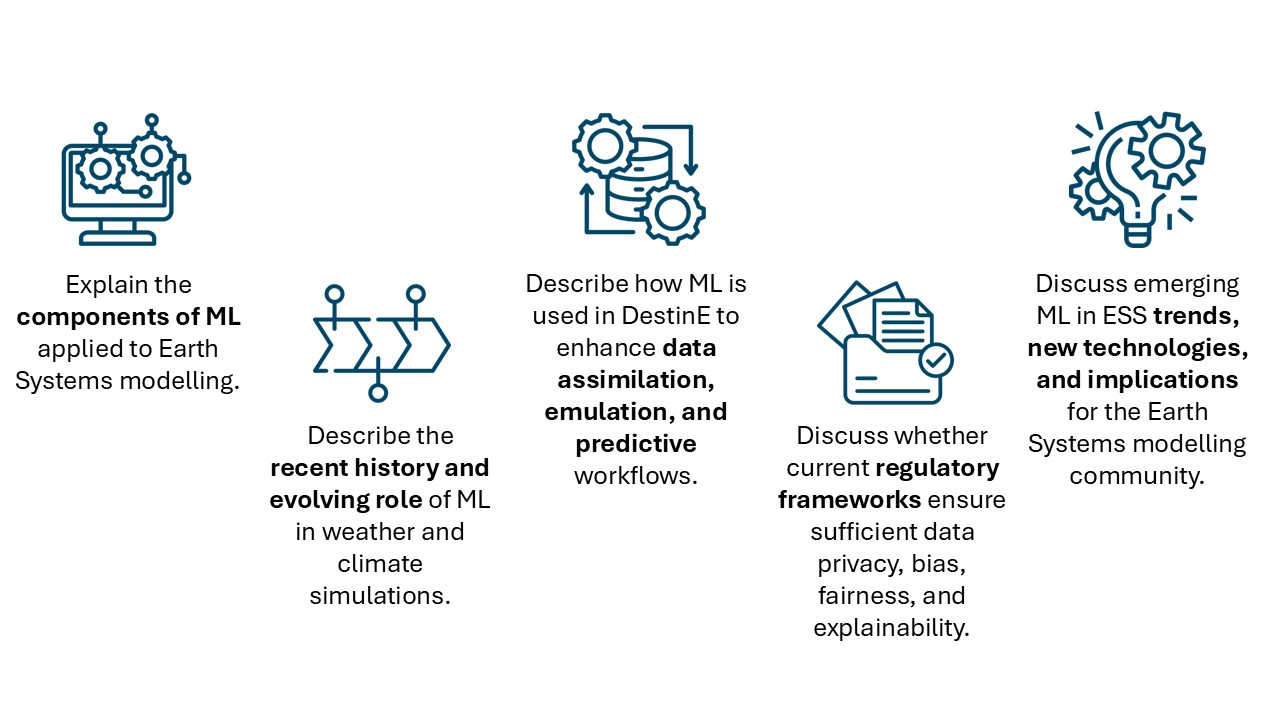
This third and final course of the series, Machine Learning for Earth Systems Modelling: Applications and Future Directions, focuses on advanced applications of ML across weather, climate, and Earth Systems Science. Participants will explore how ML methods can be applied to extreme events, explainability and trust, foundation and hybrid models, sub-seasonal and long-range prediction, downscaling, coupled Earth systems, data assimilation, and end-to-end forecasting workflows.
With a strong hands-on emphasis, the course combines expert lectures and talks with Jupyter notebooks, readings, panel discussions and quizzes. It is designed both as the final step in the three-course learning pathway and as a collection of standalone advanced modules for experienced practitioners.
Course information and registration
Estimated study load: Approximately 16-24 hours
Format: Online, self-paced, primarily asynchronous, with a strong hands-on component
Participation: Free and open to anyone interested who meets the recommended prerequisites
If you are interested in taking the course, you can already register your interest by logging in and enrolling at the bottom of this page.
Objectives
By the end of this online course, Machine Learning for Earth Systems Modelling: Applications and Future Directions, you will have developed the knowledge and skills outlined in the learning outcomes below.
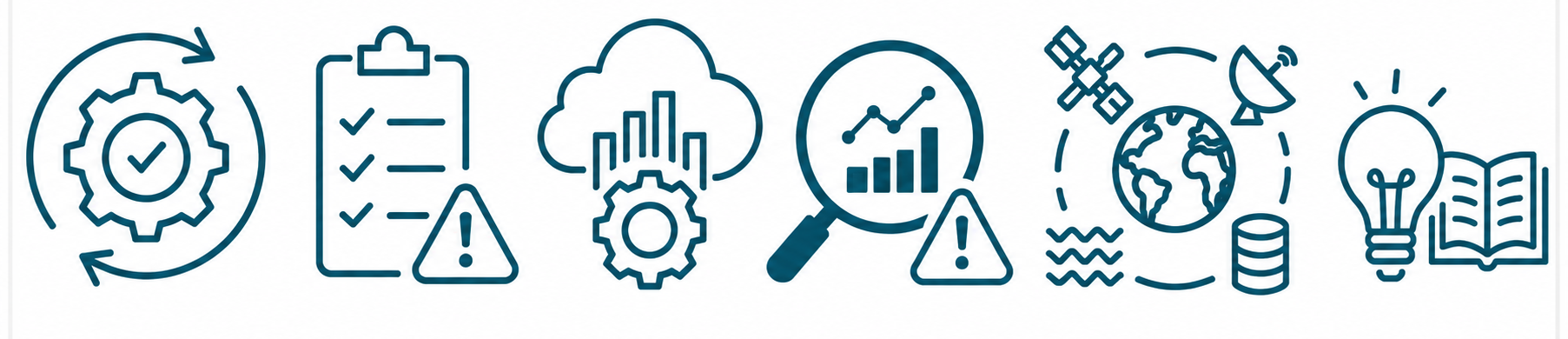
Implement ML workflows for real world Earth system applications
Evaluate the operational readiness, and limitations of ML based systems
Understand foundation and hybrid modelling strategies for Earth system science
Diagnose failure modes and instability in ML based forecasts
Apply ML approaches to downscaling, data assimilation, coupling, and long-range prediction
Critically assess emerging research directions in ML for weather, climate, and Earth system modelling
Target audience
This course is the third and final course in the three-part DestinE online training series on Machine Learning for Earth Systems Modelling.
Course 3 - Applications and Future Directions is an advanced technical course aimed primarily at:
Researchers and developers in weather, climate, and Earth-system science
Operational numerical weather prediction (NWP) and climate model developers
ML researchers working with environmental or geophysical data
Advanced PhD students and postdoctoral researchers
The course can be followed as the final step in the complete three-course programme or as standalone advanced modules by experienced practitioners with the required technical background.
Prerequisites
Participants are expected to have:
Familiarity with Python and Python-based ML ecosystems
Experience with NumPy/xarray and PyTorch or JAX
An understanding of the fundamentals of numerical weather prediction and Earth system modelling
Knowledge of core ML methods covered in Courses 1 and 2
Prior completion of Course 1 – Foundations and New Frontiers and Course 2 – Architectures, Data and Prediction is recommended for learners who do not already have equivalent knowledge and experience.
Course structure and content
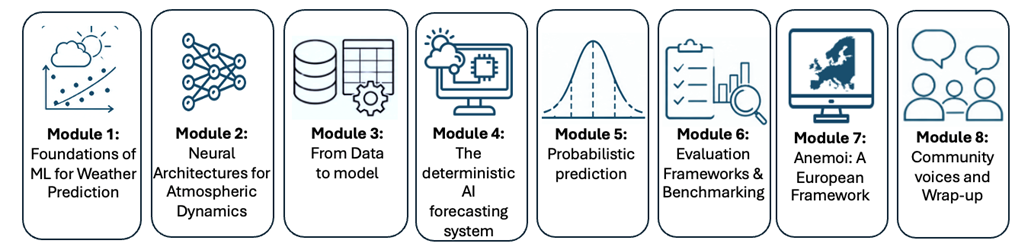
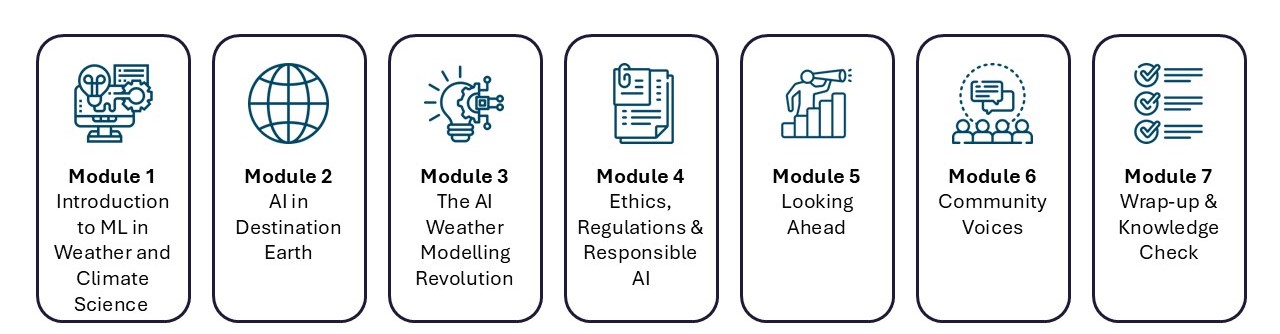
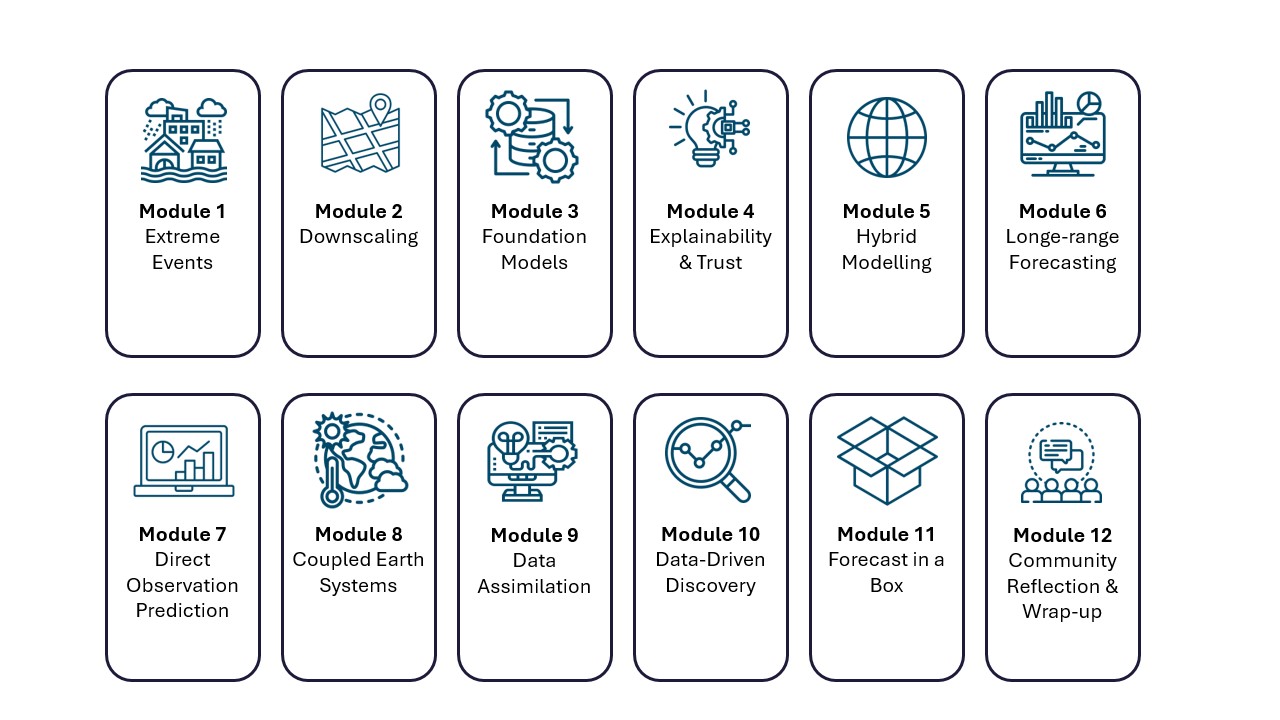
The course consists of 12 modules covering advanced applications and emerging directions in machine learning for Earth-system modelling. The modules move from applied ML workflows for extreme events to explainability, foundation and hybrid models, long-range prediction, downscaling, coupled Earth systems, ML-based data assimilation, end-to-end modelling, operational forecasting workflows, and data-driven scientific discovery.
The course has a strong practical emphasis. Learning materials include recorded lectures and expert talks, Jupyter notebooks using real-world workflows, Python scripts, demonstrations, readings, quizzes, reflective activities, and expert discussions.
The modules are:
Course lecturers and contributors
This course was created by ECMWF under the Destination Earth (DestinE) initiative of the European Commission’s DG Connect and contracted to Wageningen University (WU), in collaboration with the Karlsruhe Institute of Technology (KIT) and Wageningen Research (WR). Scientific content is provided by experts from ECMWF, academia, research institutes, meteorological organisations, and industry.
Contributors are involved in topics ranging from extreme-event applications and explainable AI to foundation models, hybrid modelling, long-range prediction, downscaling, coupled Earth systems, data assimilation, end-to-end forecasting, and data-driven discovery.
Experts include (to be updated):
Eduardo Acuna Espinoza, Karlsruhe Institute of Technology (KIT)
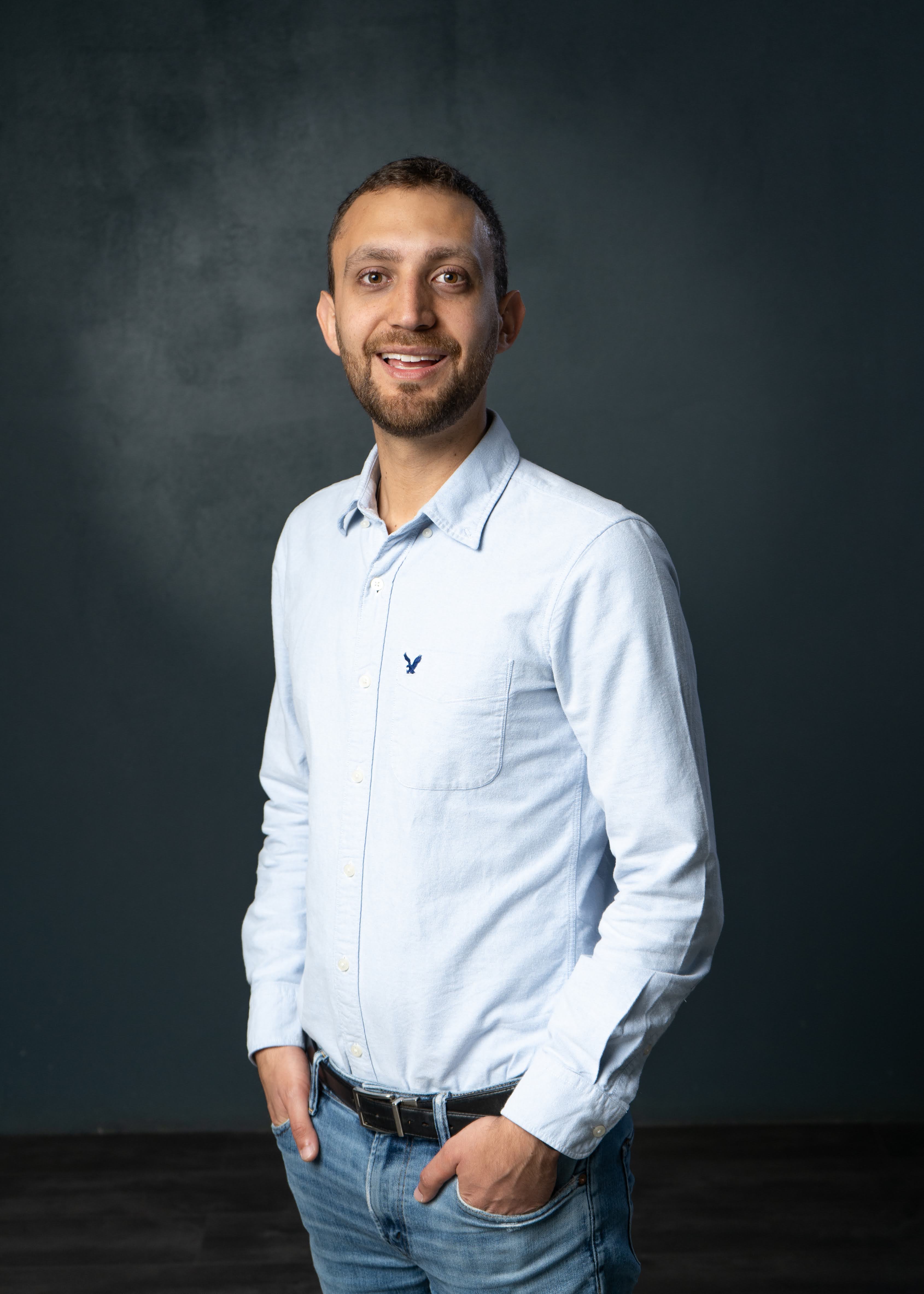
Eduardo
is a civil engineer and researcher from Costa Rica who focuses on hydrological
and hydraulic modelling, with applications in flood forecasting. He earned his
PhD from the Karlsruhe Institute of Technology (Germany), a master's degree
from the University of Stuttgart (Germany), and a bachelor's degree from the
University of Costa Rica. Currently, Eduardo applies machine learning methods
for hydrological and hydrodynamic modeling at Hydron GmbH and conducts research
at the Institute for Water and Environment at KIT.
Mihai Alexe, European Centre for Medium-Range Weather Forecasts (ECMWF)
Tom Beucler, Assistant Professor of Environmental Data Science at University of Lausanne
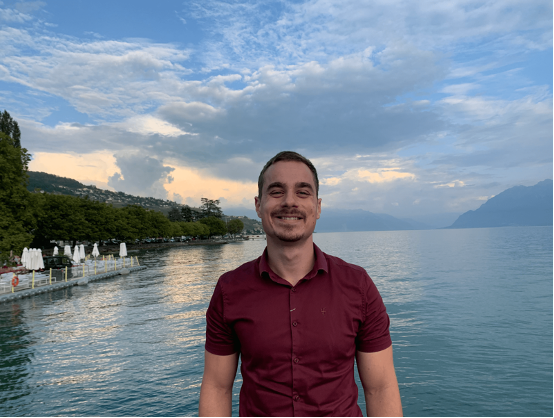
Tom Beucler leads the Data-Driven Atmospheric & Water Dynamics (∂3AWN) laboratory, the first research group worldwide dedicated to bridging atmospheric physics and AI. Tom holds a Ph.D. in atmospheric science from MIT, where he studied tropical convection. His postdoctoral work at Columbia University and UC Irvine focused on deep learning for climate modeling.
Niklas Boers, Potsdam Institute for Climate Impact Research (PIK) and Technical University of Munich (TUM)
Eulalie Boucher, Scientist for Machine Learning at the European Centre for Medium-Range Weather Forecasts (ECMWF)
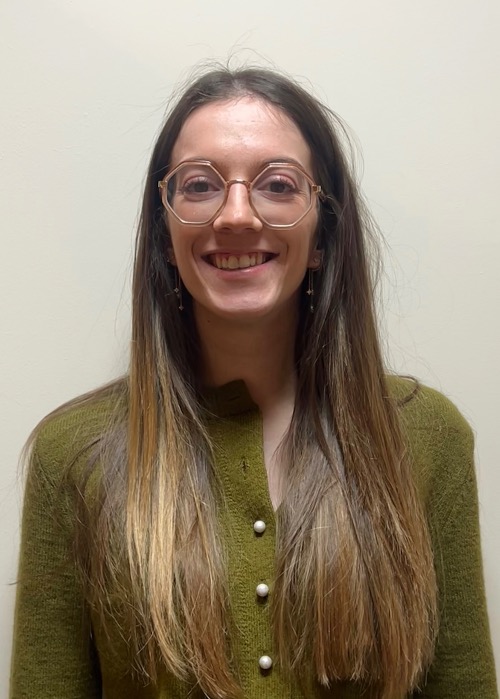
Eulalie Boucher is a Scientist for Machine Learning at ECMWF, working on AI-DOP, focusing on end-to-end forecasting from observations only. Eulalie completed a PhD at the Observatoire de Paris | PSL, where the research explored the use of deep learning for satellite infrared spectrometer observations. The work combines machine learning and Earth observation data for weather and climate applications.
Harrison Cook, Research Scientist at the European Centre for Medium-Range Weather Forecasts (ECMWF)
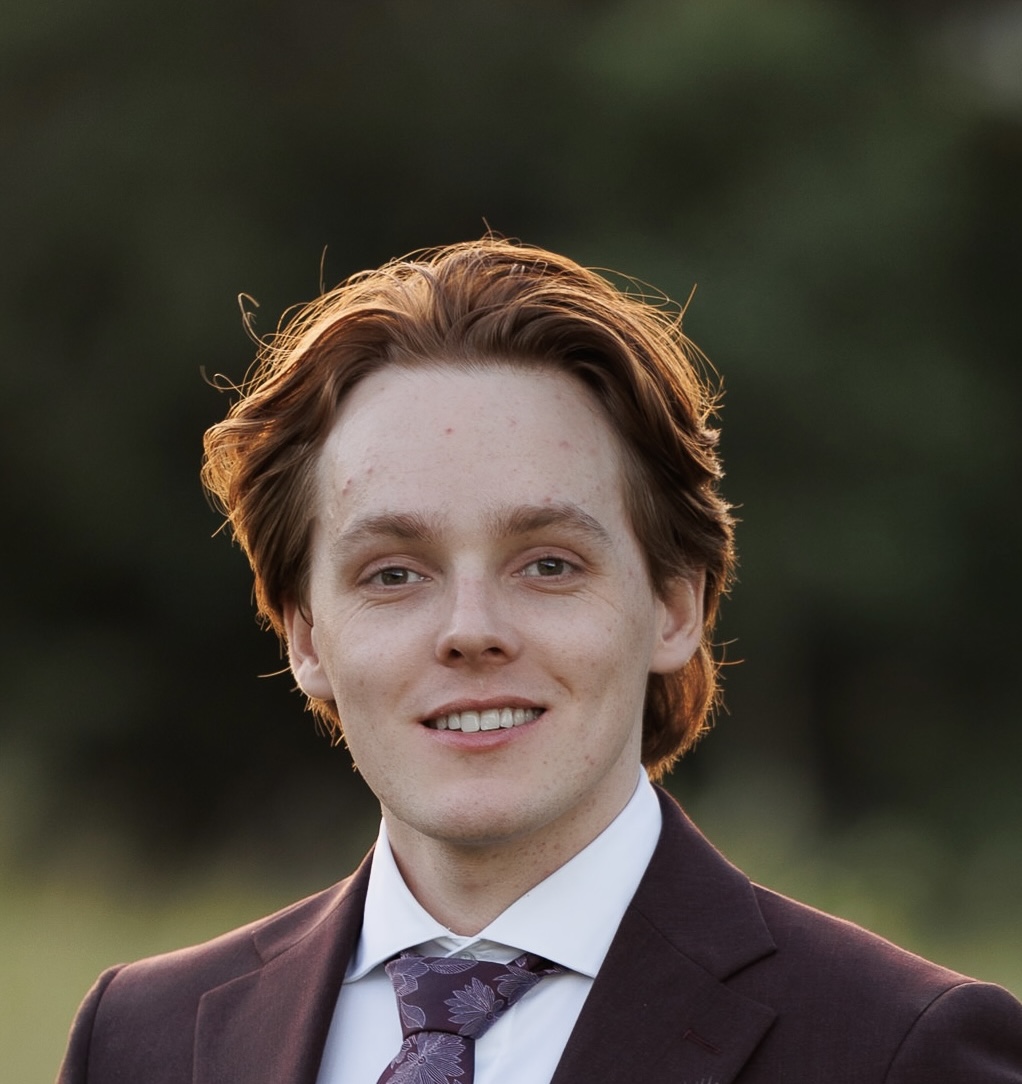
Jesper Dramsch, Scientist for Machine Learning at the European Centre for Medium-Range Weather Forecasts (ECMWF)

Jesper Dramsch is a Scientist for Machine Learning at ECMWF, working on AI-driven weather forecasting systems. They are a core developer of the Artificial Intelligence Forecasting System (AIFS) and contribute to Anemoi, the open-source machine learning framework for weather forecasting developed with European national meteorological services. Their work focuses on graph neural networks, scalable AI infrastructure, and operational machine learning workflows for numerical weather prediction. They're a Software Sustainability Institute Fellow focused on reproducible research and co-organised ECMWF's first MOOC on Machine Learning in Weather and Climate, as well as, contributes to training activities for ECMWF Member States, write the newsletter "Late to the Party", and have a knack for cutting through hype. Jesper also serves as co-chair of the Working Group Modelling within the UN ITU Global Initiative on AI for Natural Disaster Management.
Joffrey Dumont, European Centre for Medium-Range Weather Forecasts (ECMWF)
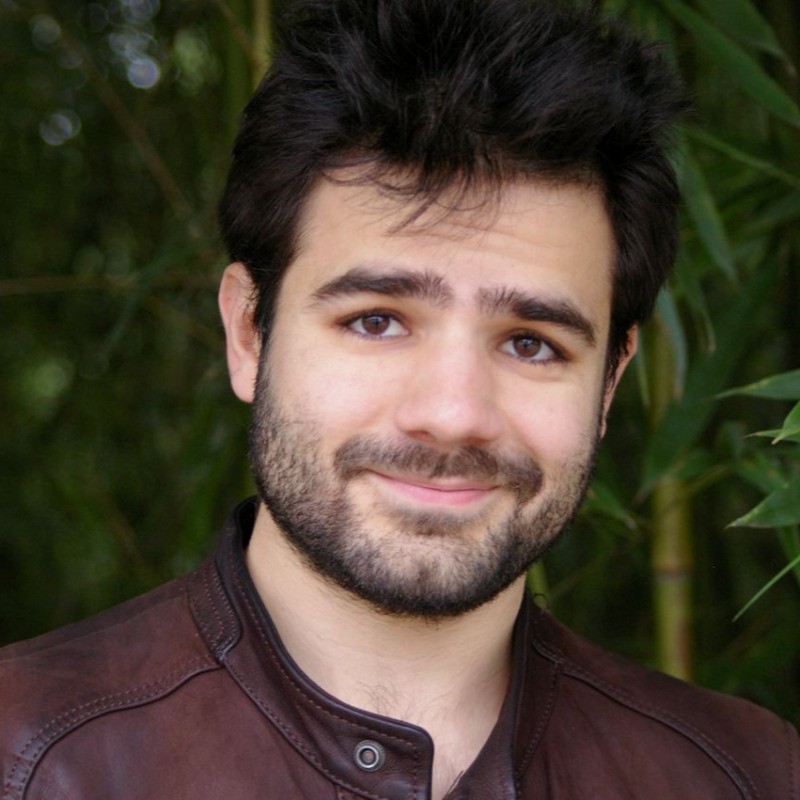
Sebastian Engelke, Professor of Statistics and AI at the University of Geneva
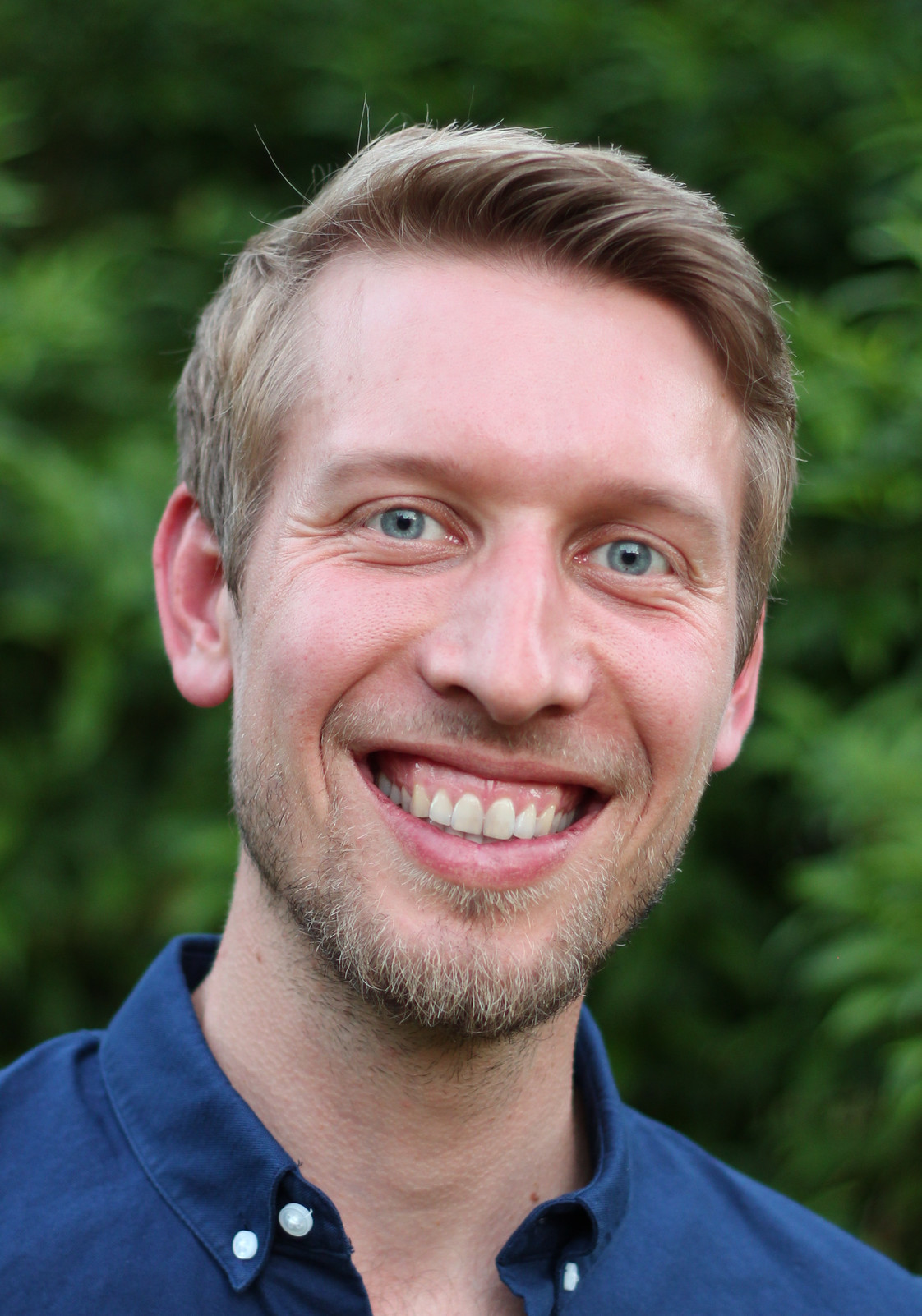
Veronika Eyring, Professor of AI for Climate and Physical Systems at the University of Tübingen, connAIx Heilbronn & Tübingen AI Center
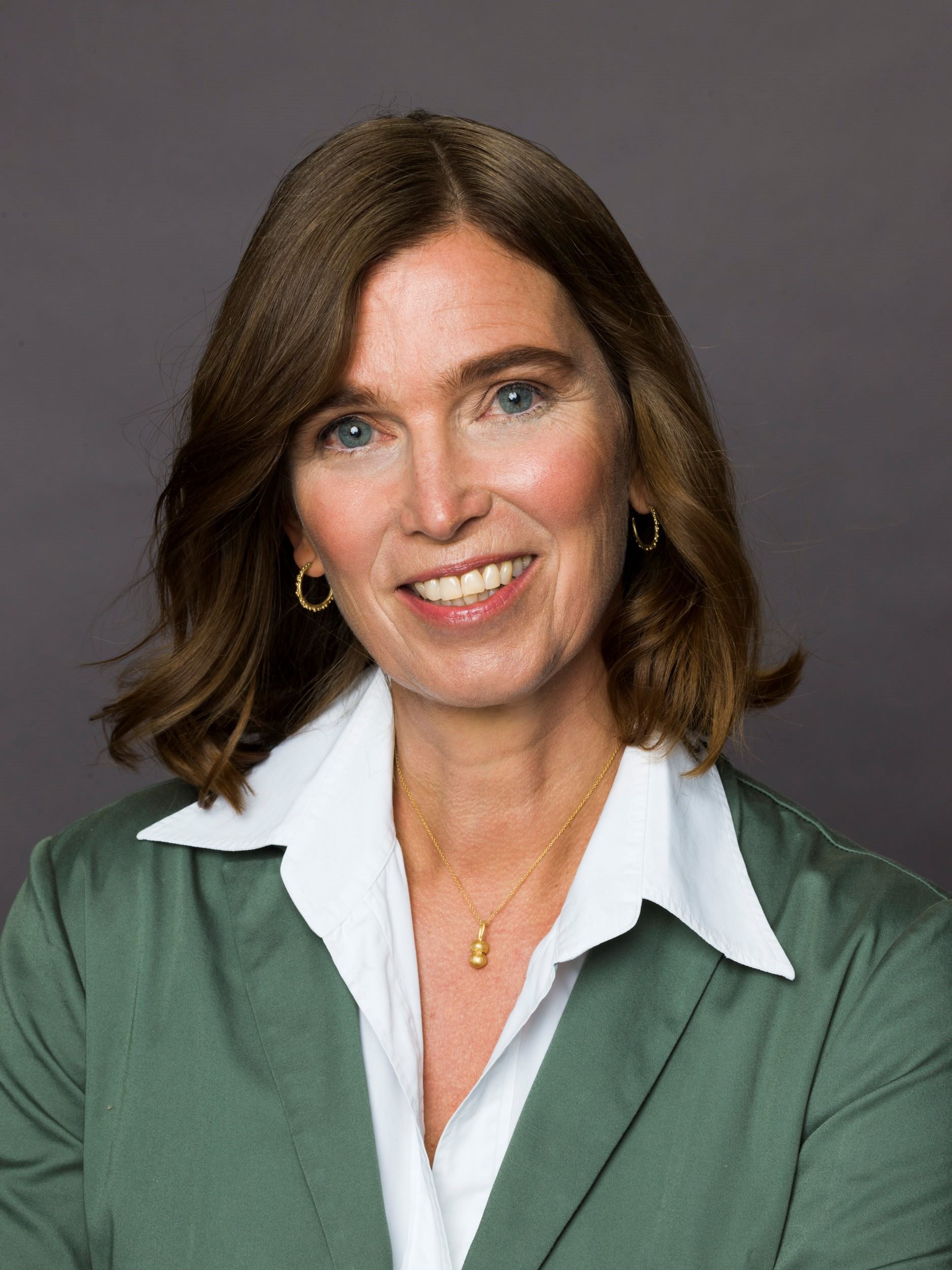
Marco Froelich, University of Geneva
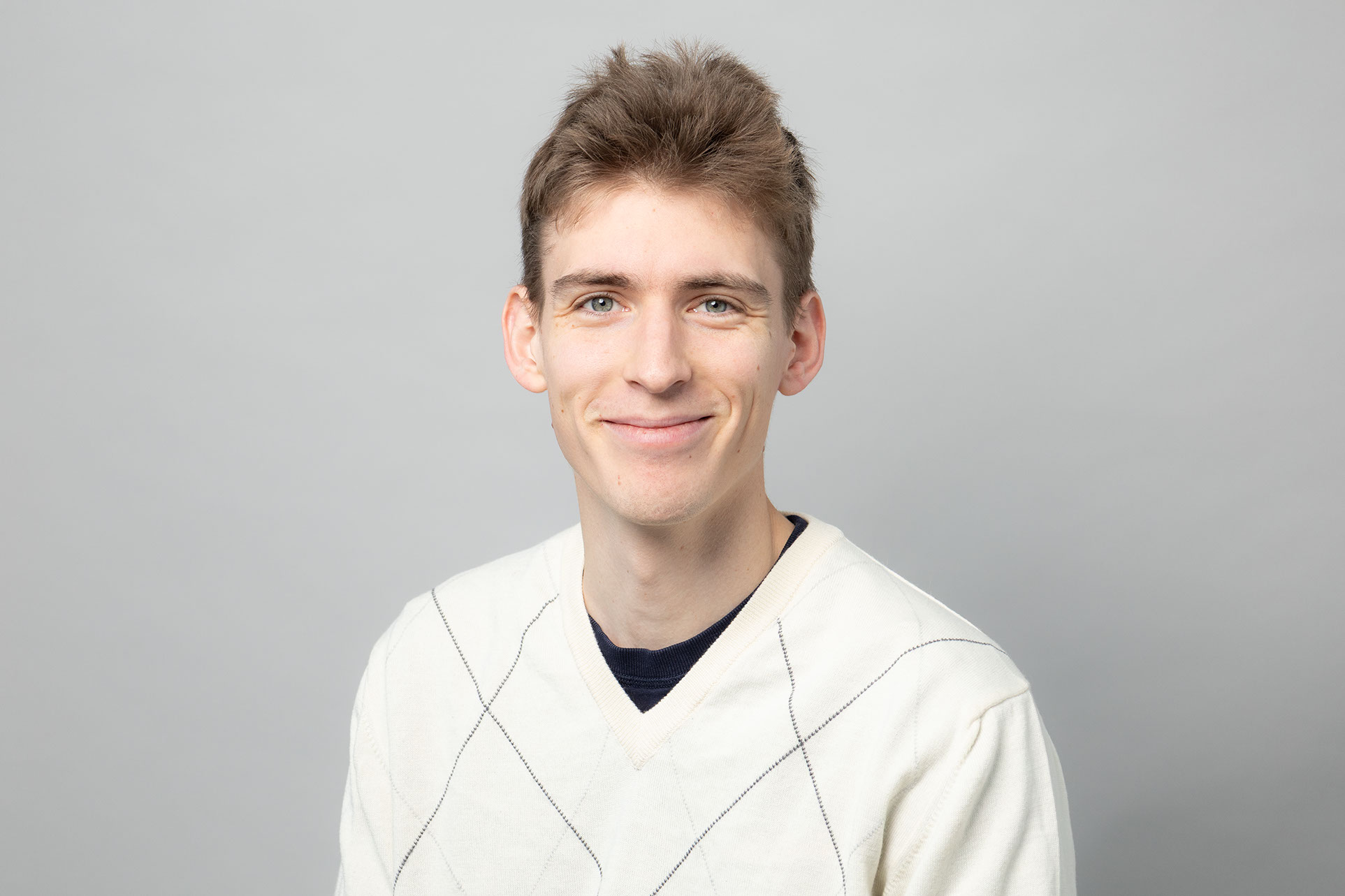
Marco Froelich is a PhD candidate in Statistics at the University of Geneva under Prof. Sebastian Engelke. His research focuses on weather forecasting and the role that AI weather models will play in future operational systems in the context of a changing climate with increasing meteorological extremes.
Rachel Furner, Scientist Ocean Modelling at the European Centre for Medium-Range Weather Forecasts (ECMWF)
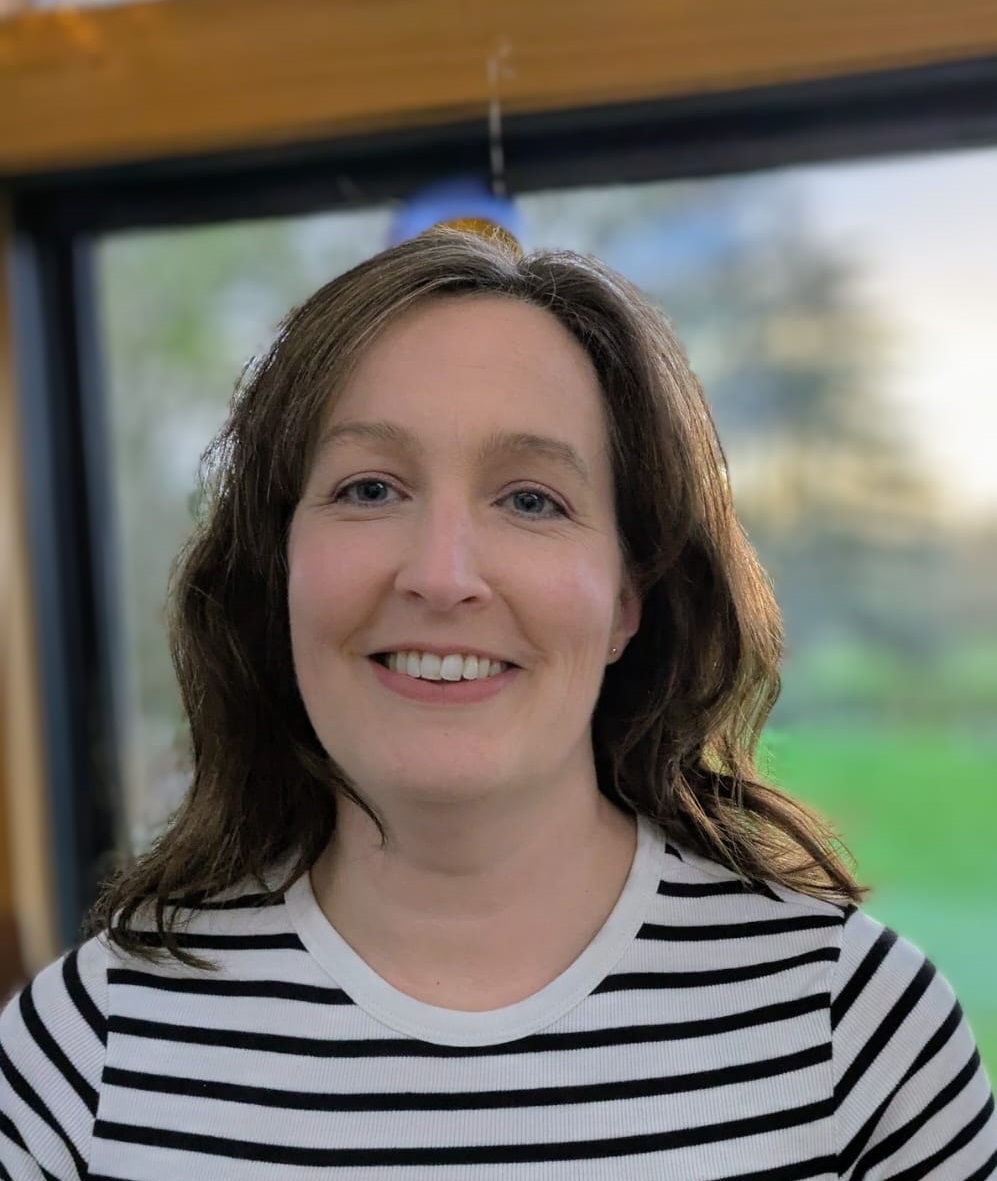
Rachel is a research scientist at ECMWF within the ocean modelling team. She works on developing and evaluating data-driven ocean models. Her work focuses on using and adapting ANEMOI to train predictive models of the ocean, using machine learning. This includes assessing different architecture options, data sources and resolution, and training methodologies. Rachel began her career developing physics-based ocean models. More recently, in 2024 she completed a PhD investigating data-driven ocean modelling, building emulators of idealized ocean configurations.
Saranya Ganesh Sudheesh, University of Lausanne
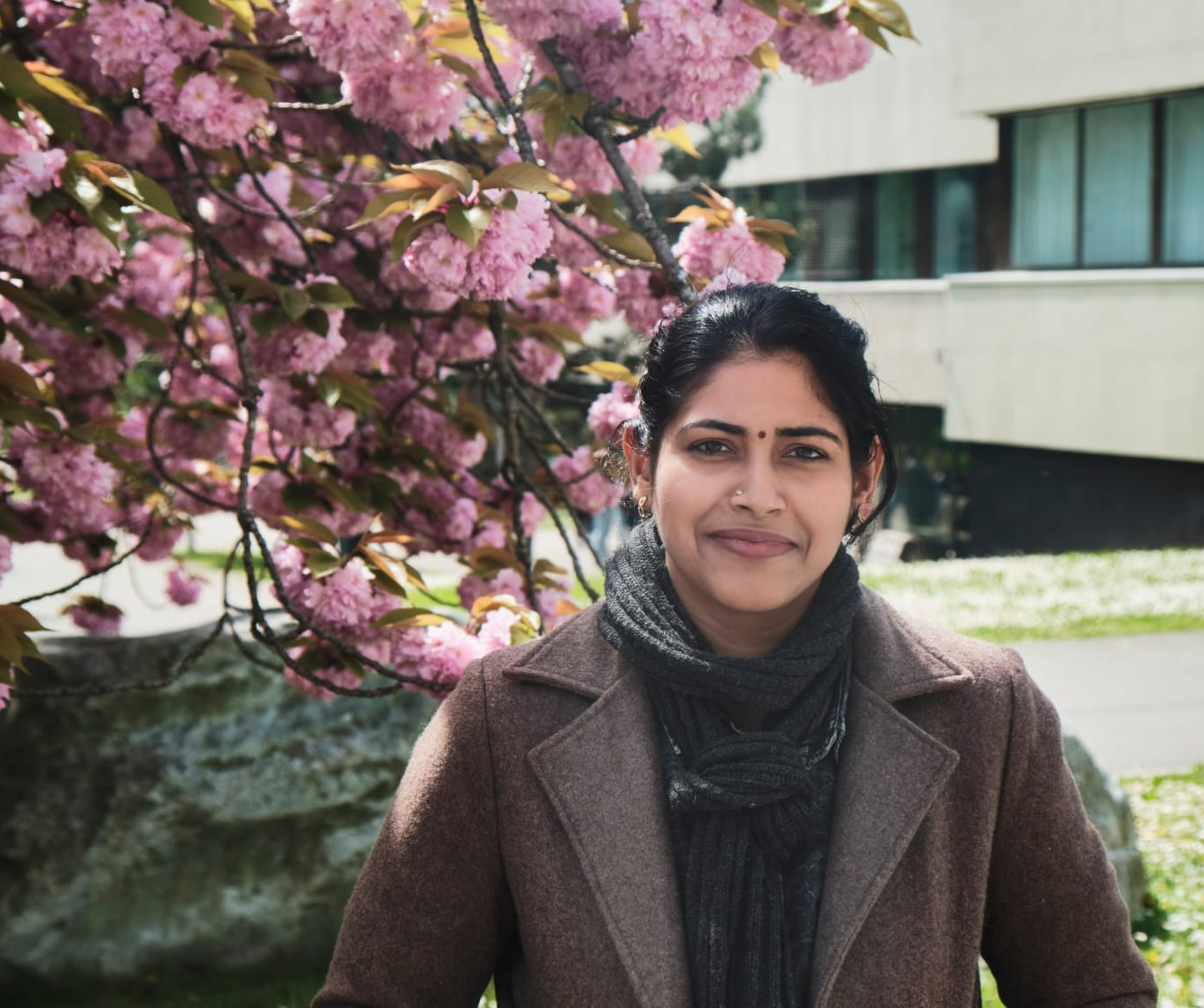
Dr.
Saranya Ganesh S. is an atmospheric scientist and Research Affiliate at the
Data-driven Atmospheric and Water Dynamics (DAWN) Lab, University of Lausanne,
where she worked as a postdoctoral researcher. She holds a PhD from the Indian
Institute of Tropical Meteorology (IITM), where she developed a North Indian
Ocean tropical cyclone prediction system and contributed to improved
operational cyclogenesis forecast products for early warning. She is interested
in extreme weather predictability, cyclone dynamics, and interpretable machine
learning for weather and climate. Her recent work applies multidata causal
discovery to identify robust, physically meaningful predictors for statistical
hurricane intensity prediction.
Alan Geer, European Centre for Medium-Range Weather Forecasts (ECMWF)
Alan Geer is a principal scientist at ECMWF, where he develops methods to make better use of satellite observations in weather forecasting. His work spans data assimilation, remote sensing and machine learning. He is particularly interested in how physical knowledge and statistical learning can be combined to improve environmental prediction. Over his career, he has contributed to the development of all-sky satellite data assimilation and more recently its extension to earth surfaces, all-surface assimilation. His current research focuses on the physical characteristics of sea ice, using hybrid physical-empirical approaches that combine prior physical knowledge with data-driven methods.
William Gregory, University College London (UCL)
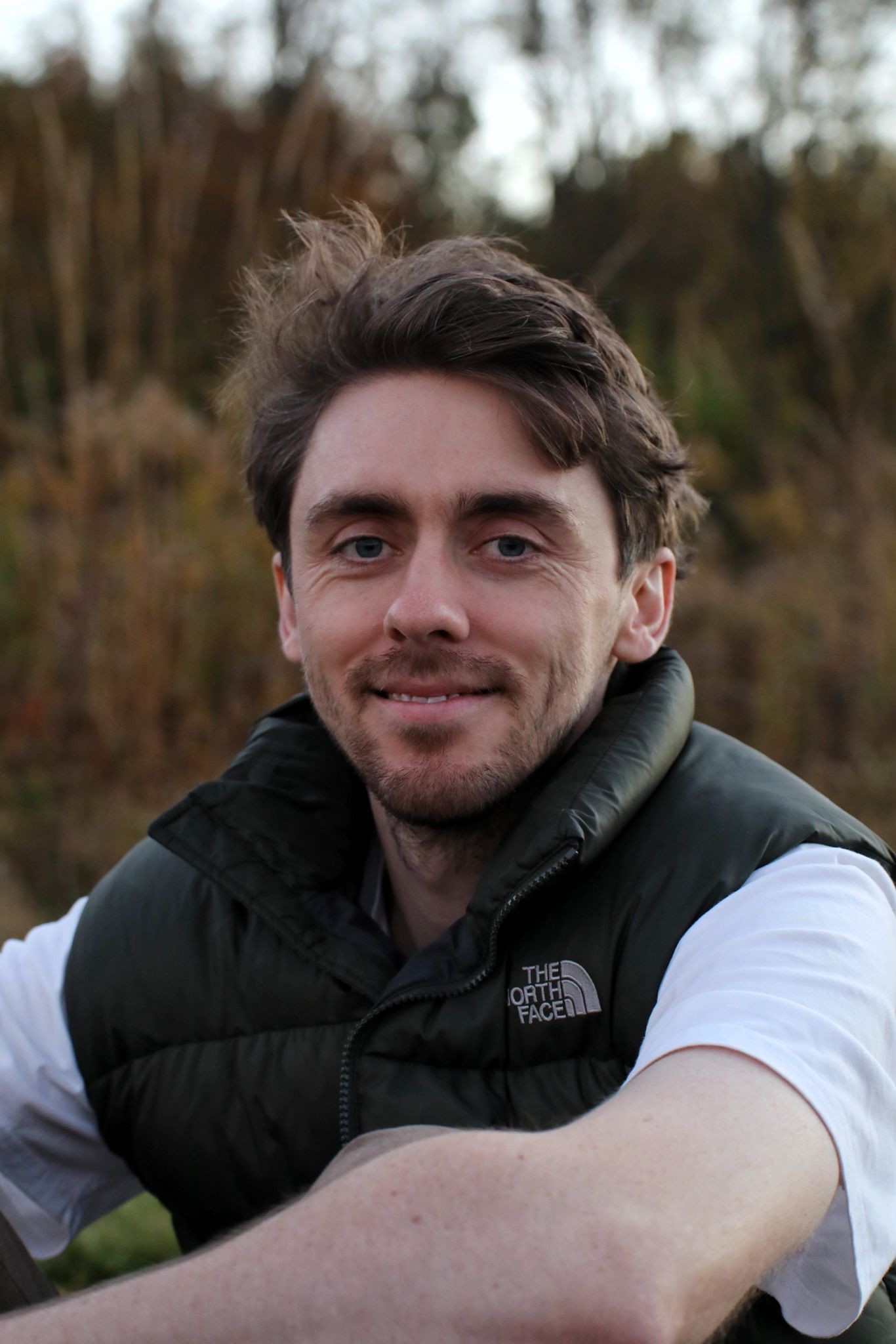
Will Gregory is a Marie Skłodowska-Curie Actions Fellow at University College London (UCL), where he uses AI to improve sea ice and snow physics within coupled climate models and also develop coupled climate model emulators. His broader focus is on sea ice predictability and understanding large-scale polar climate change. Prior to UCL, Will was a postdoctoral research associate at Princeton University, where he worked closely with the NOAA Geophysical Fluid Dynamics Laboratory on using AI to improve sea ice predictions in their coupled seasonal-to-decadal prediction model.
Arthur Grundner, German Aerospace Center (DLR)
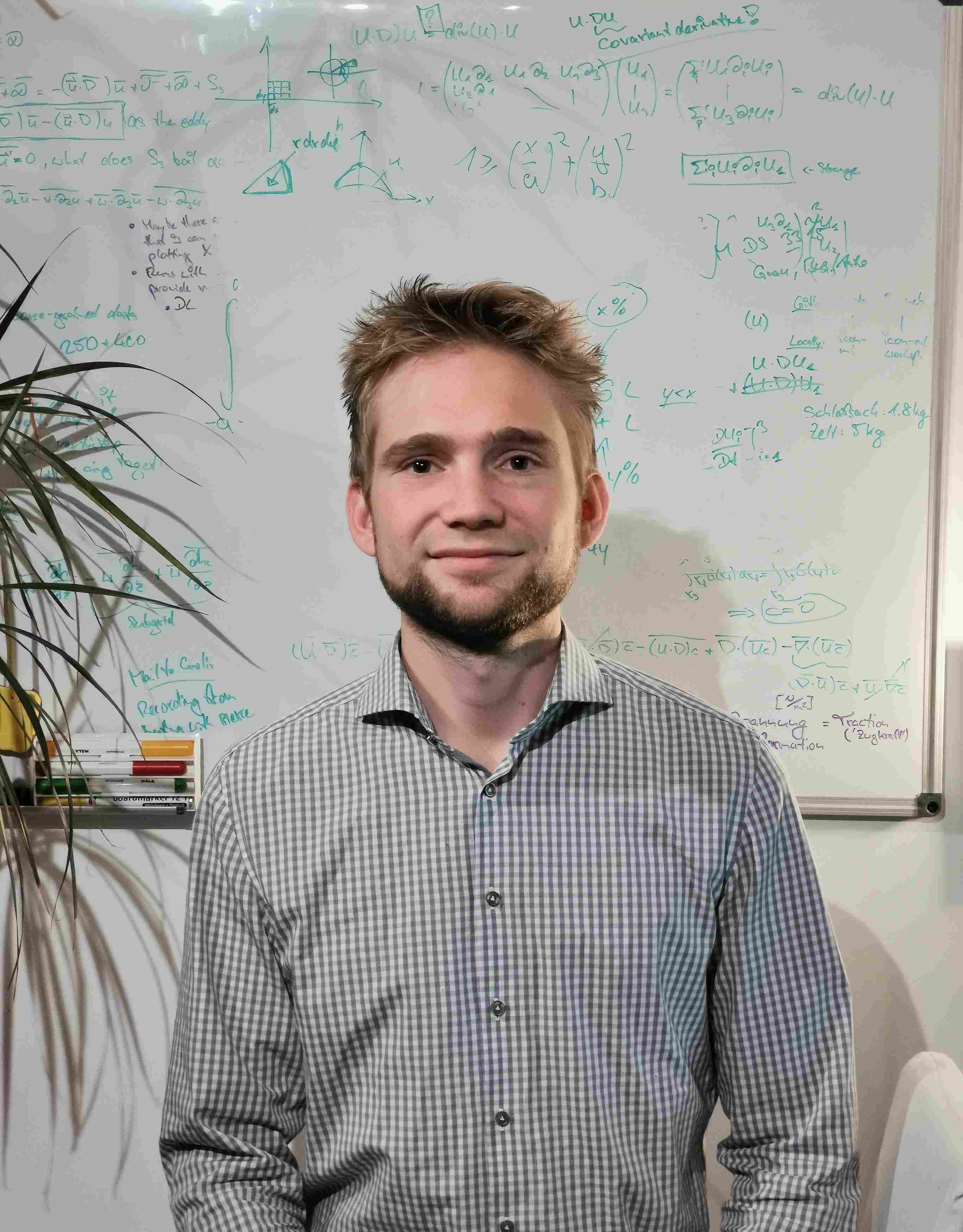
He co-leads the largest work package of the AI4PEX EU Horizon project, which develops ML-based parameterizations for key processes in Earth System Models.
He joined the DLR in 2019 after completing his studies in mathematics and has since worked on efficient and interpretable ML-parameterizations, with a focus on clouds and the ICON model.
Tijana Janjic, Heisenberg Professor of Data Assimilation at the Mathematical Institute for Machine Learning and Data Science, Catholic University of Eichstätt–Ingolstadt
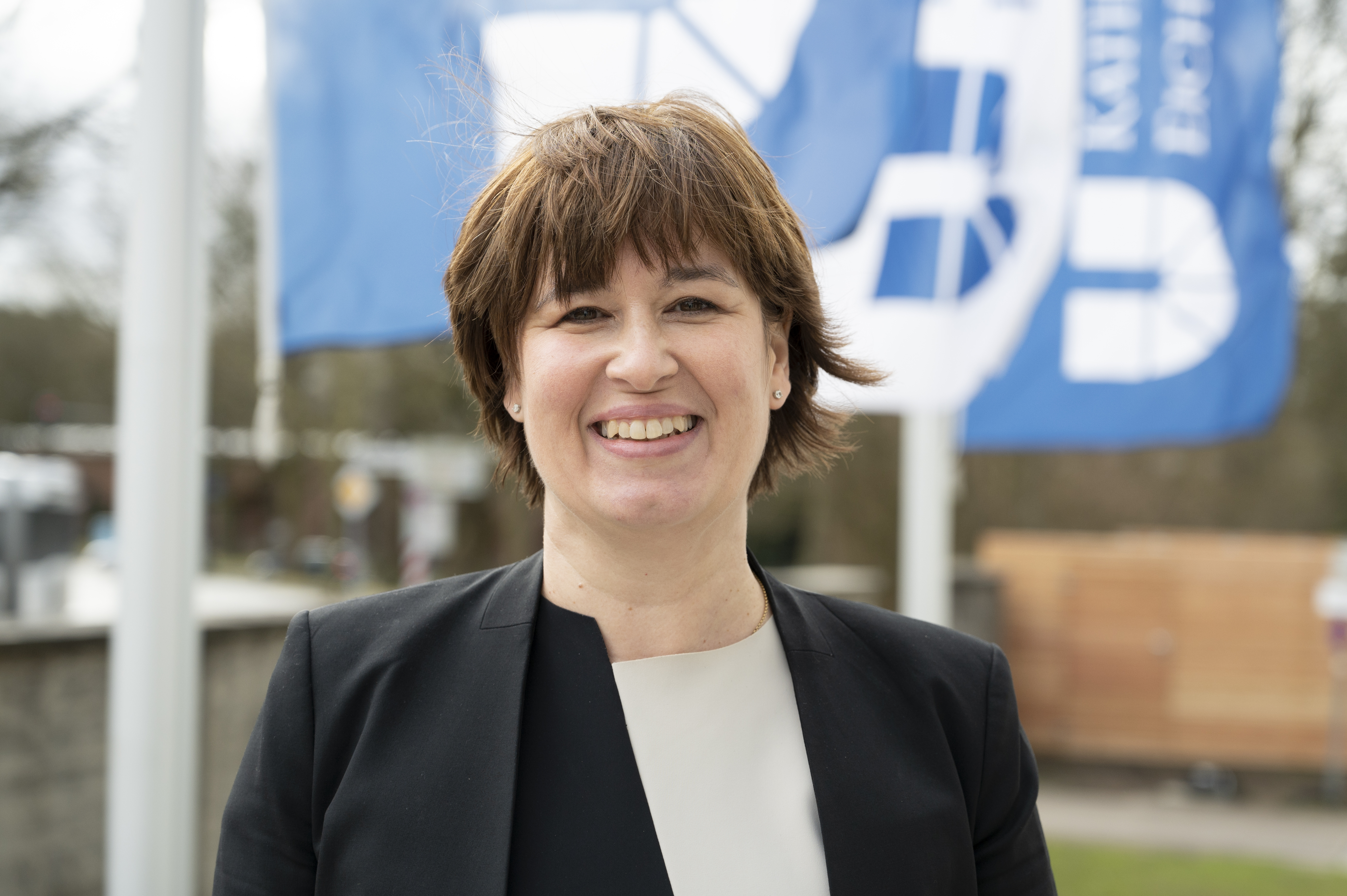
Katie Kowal, University of Chicago
Peter Lean, Senior Scientist at European Centre for Medium-Range Weather Forecasts (ECMWF)
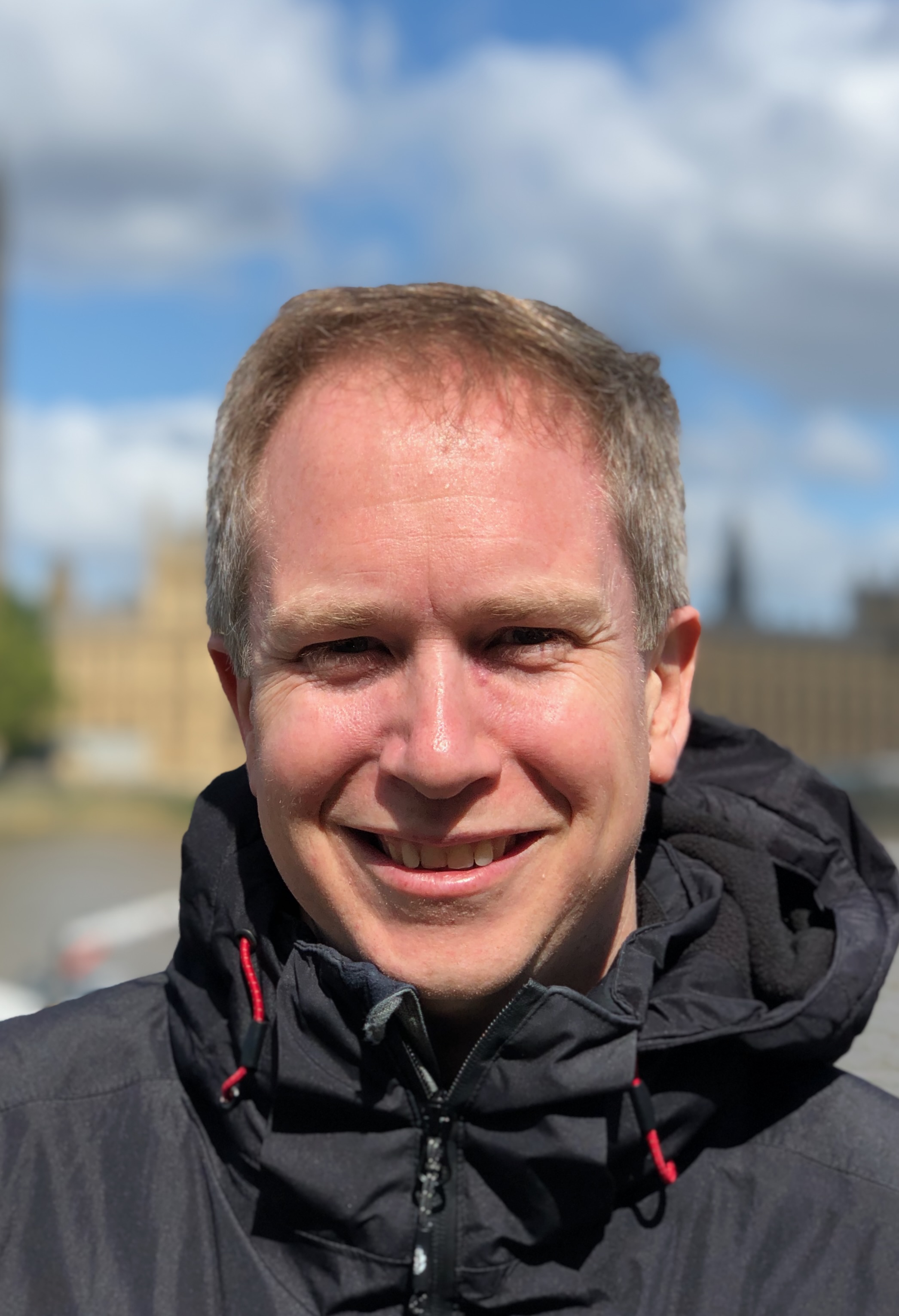
Peter Lean is a Senior Scientist at ECMWF working in the Earth System Assimilation Section. His background is in data assimilation and observation processing, but in recent years has become increasingly involved with machine learning. His current research involves exploring the extent to which machine learning weather prediction models can be trained on observational data. Previously, Peter worked on mesoscale model development at the UK Met Office before completing postdoctoral positions at NASA JPL and at the University of Reading as a EUMETSAT Fellow.
Carolina Natel, Postdoctoral Researcher at Karlsruhe Institute of Technology (KIT)
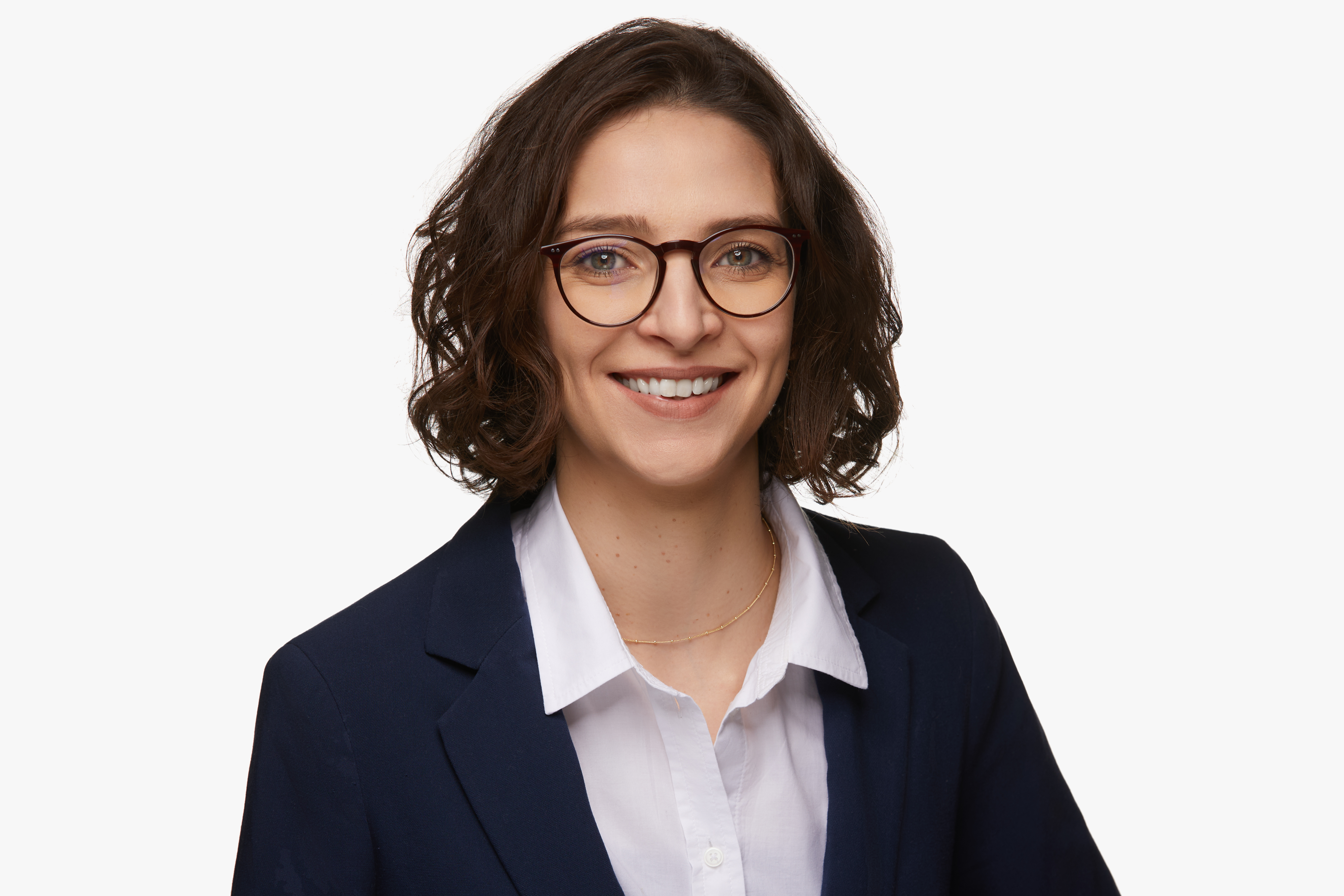
Ewan Pinnington, Scientist for Machine Learning at the European Centre for Medium-Range Weather Forecasts (ECMWF)
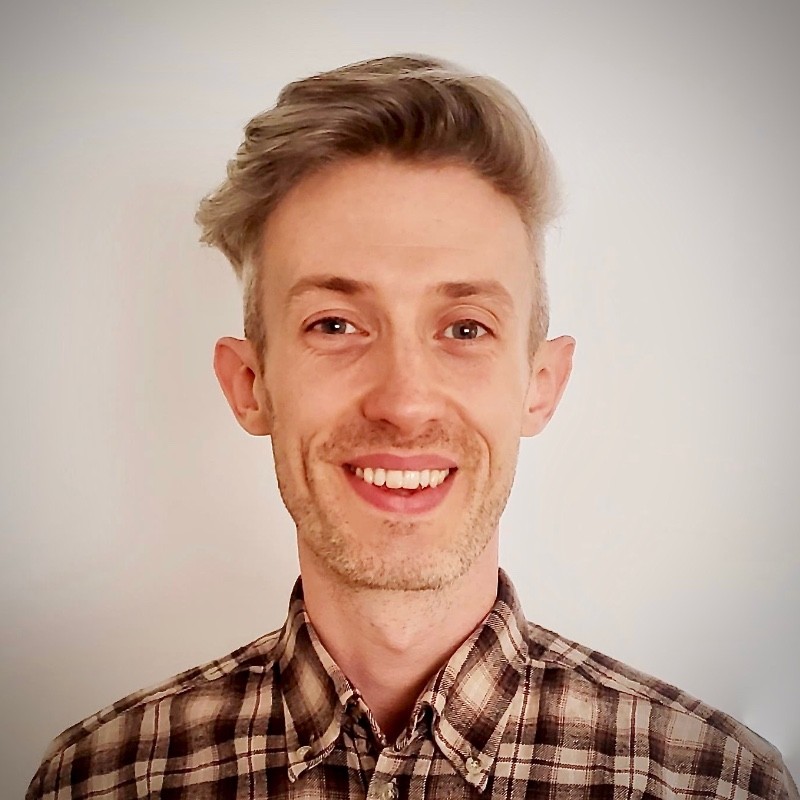
Ewan is a scientist at ECMWF developing machine learning models for weather prediction, with a focus on models trained directly on satellite and conventional observations. He began his career in data assimilation at the University of Reading, then led a team building smaller-scale ML models at a start-up. Since joining ECMWF, he has contributed to land surface data assimilation and the Artificial Intelligence Forecasting System (AIFS). He now works on Direct Observation Prediction (DOP), focusing on ML-ready dataset curation, quality control and model development. On this course, he will share lessons from building ML forecasting systems end to end.
Ana Prieto Nemesio, Machine Learning Engineer Team Lead at the European Centre for Medium-Range Weather Forecasts (ECMWF)
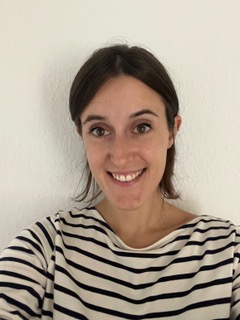
Ana Prieto Nemesio is the Machine Learning Engineering Team Lead at ECMWF, where she leads ML engineering activities and supports the development of Anemoi, an open-source data-driven weather forecasting framework co-developed with European national meteorological services. She has a background in Aerospace Engineering and holds a master’s degree in advanced computational methods and flow management. Ana began her career working on research projects at the intersection of artificial intelligence and remote sensing as a Machine Learning Engineer. She later worked as a Computer Vision Data Scientist, focusing on climate risk modelling and leading the development of a high-resolution digital terrain model using deep learning techniques.
Nina Raoult, Research Scientist at European Centre for Medium-Range Weather Forecasts (ECMWF)
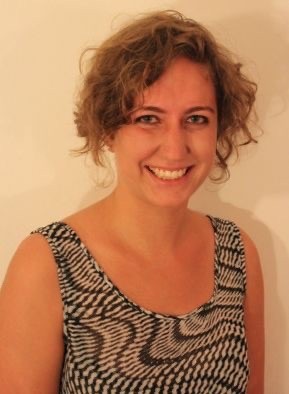
Mario Santa Cruz, Machine Learning Scientist at the European Centre for Medium-Range Weather Forecasts (ECMWF)
Mario Santa Cruz López is a Machine Learning Scientist at ECMWF, where he works on the development of AI-driven weather and Earth-system forecasting models within the Anemoi framework. His research interests include the integration of observations into operation data-driven forecasting systems, multi-domain modelling, and training strategies with multiple datasets and high-resolution modelling.
Julien Savre-Piou, Senior Scientist at the German Aerospace Center (DLR)
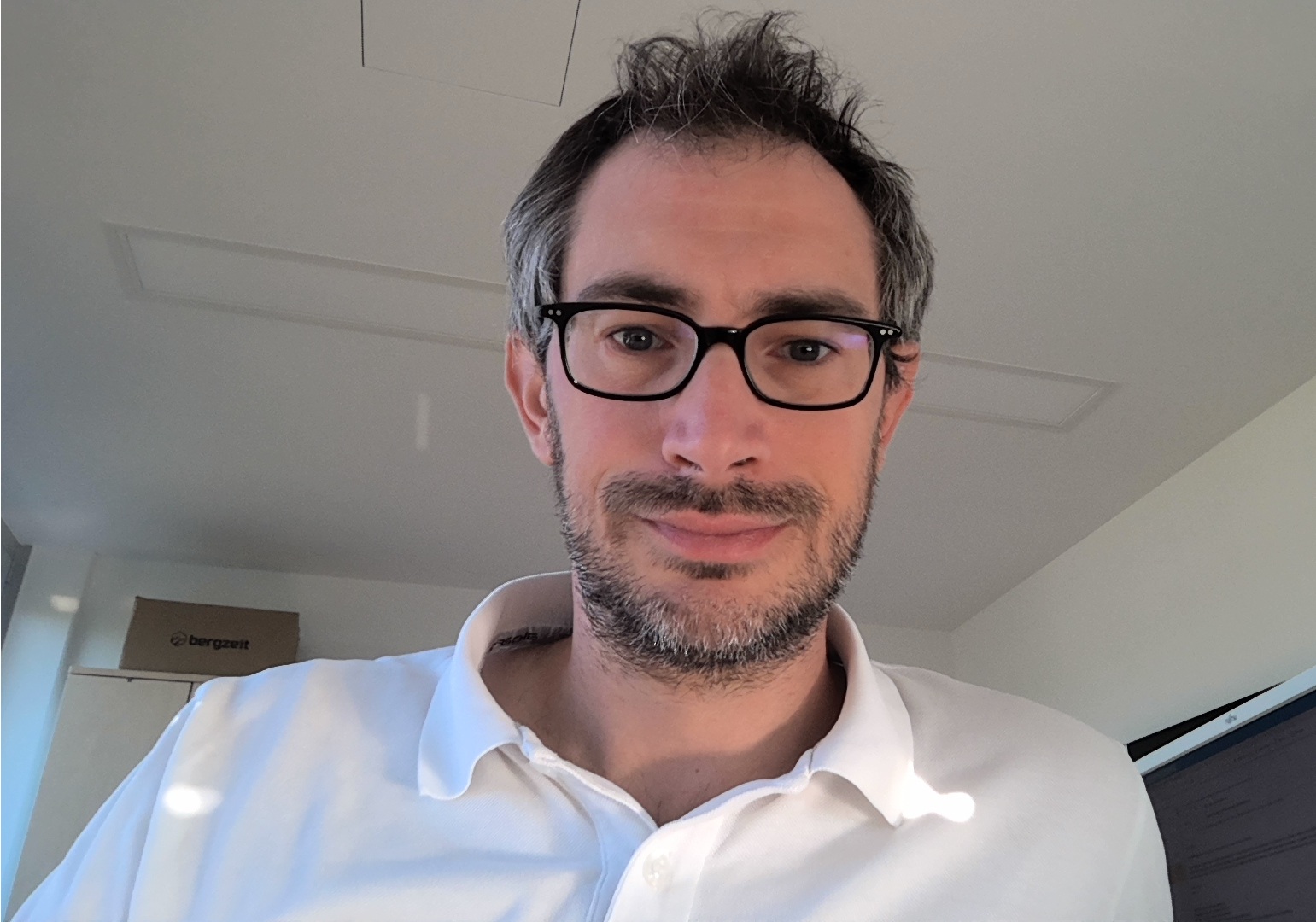
Julien
Savre is a Senior Scientist at the German Aerospace Center (DLR), where he
currently leads the development of a hybrid version of the ICON model. His
research focuses on leveraging physics-informed machine learning to advance
Earth system modelling, with a particular emphasis on developing data-driven
parameterizations to improve the representation of complex physical processes.
Prior to joining DLR, Julien held research positions at LMU Munich, the
University of Cambridge, and Stockholm University, where he worked on a range
of topics related to atmospheric and climate modelling.
Frederick Tam, University of Geneva
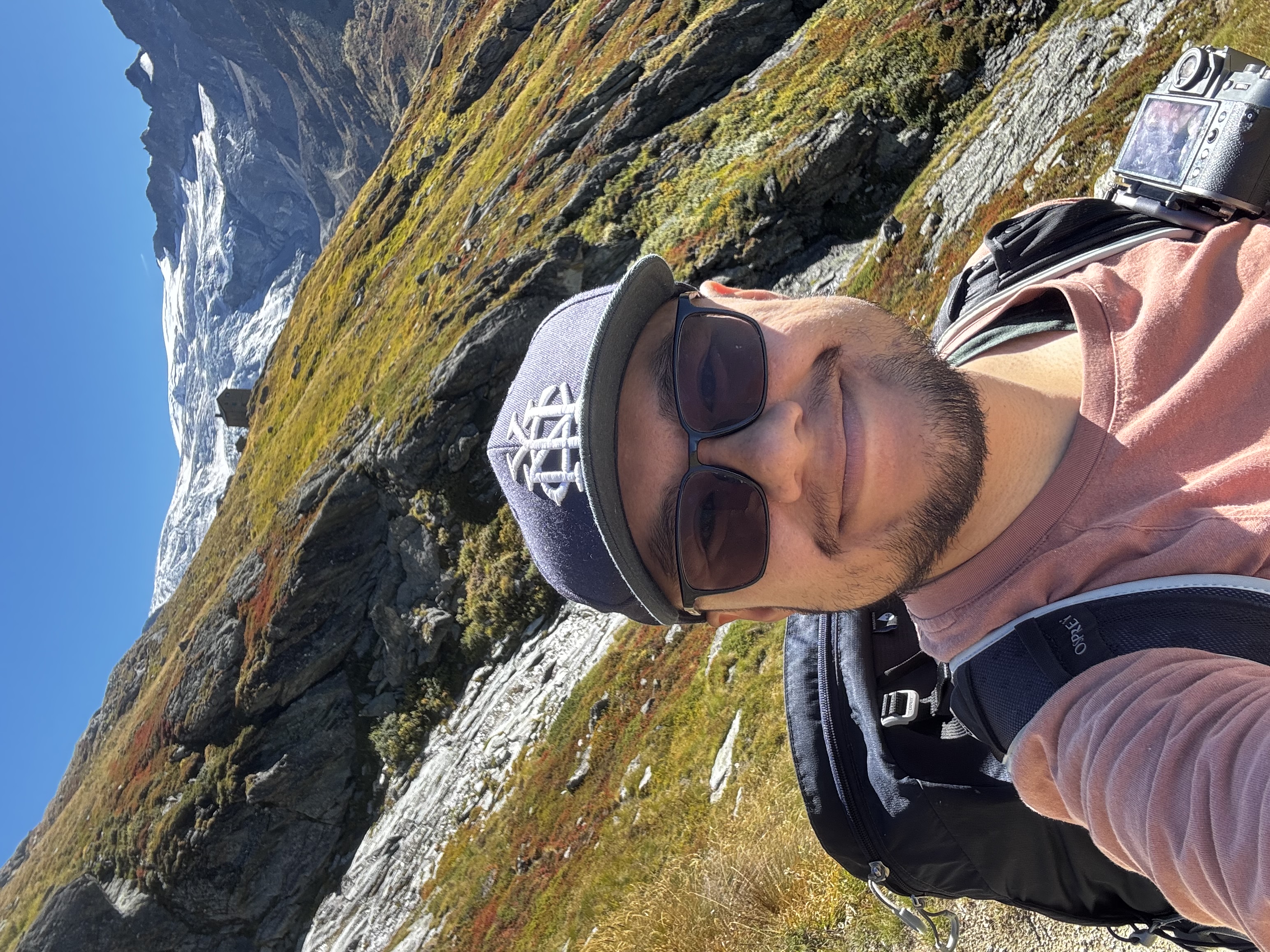
Richard Turner, Professor of Machine Learning at the University of Cambridge
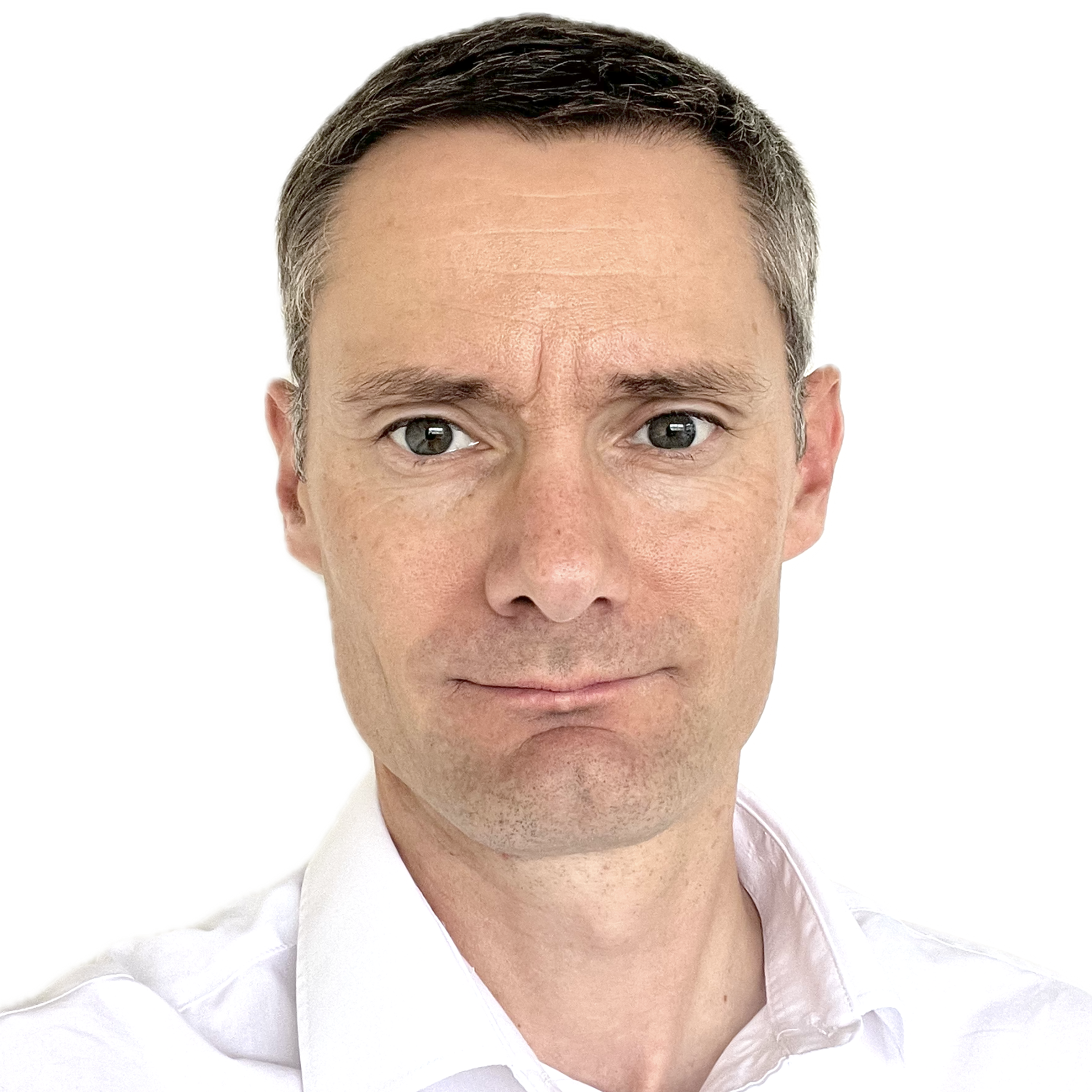
Lorenzo Zampieri, Scientist at the European Centre for Medium-Range Weather Forecasts (ECMWF)
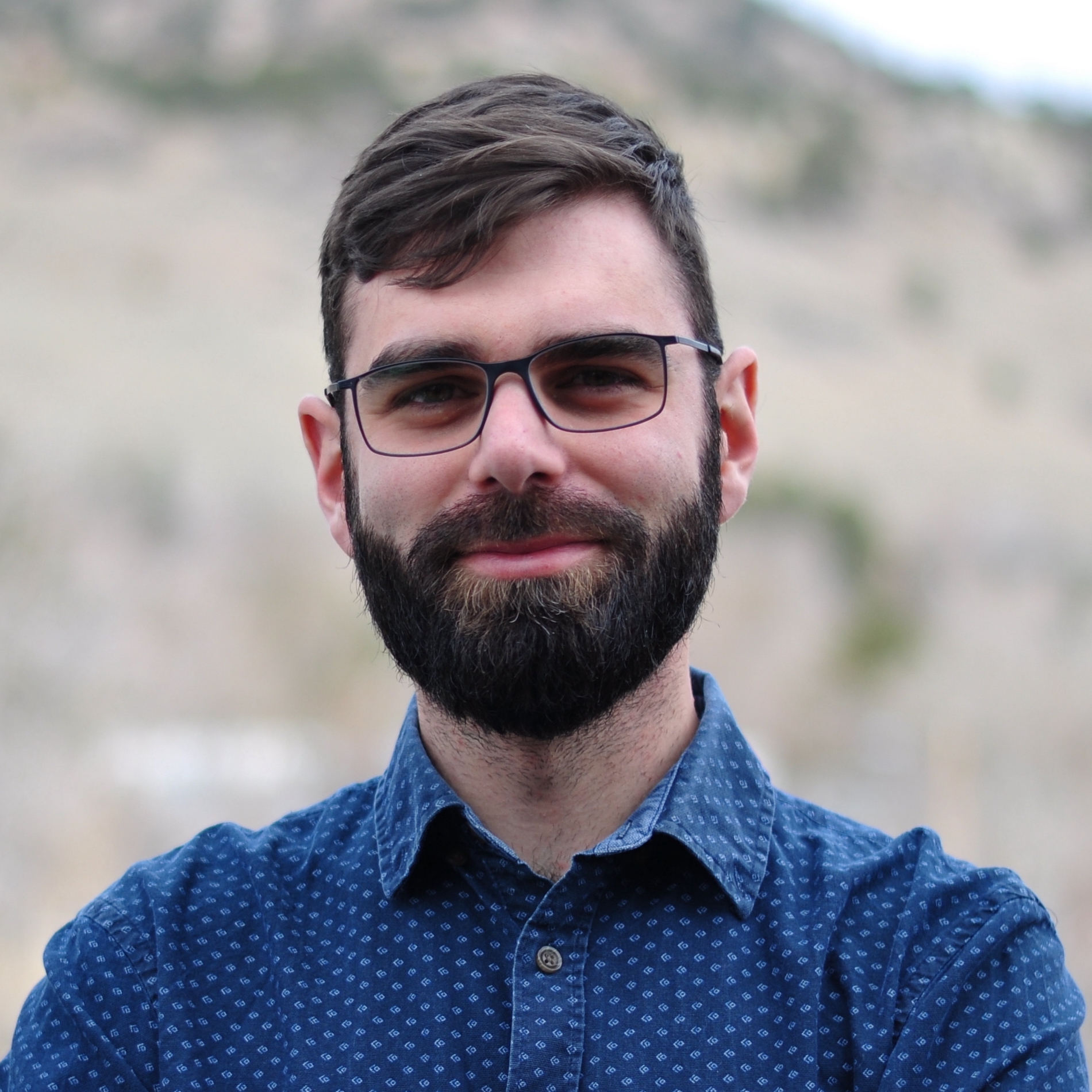
Samuel Sutanto, Assistant Professor Compound Hydrological Extremes and Climate Services at Wageningen University | Principal Investigator
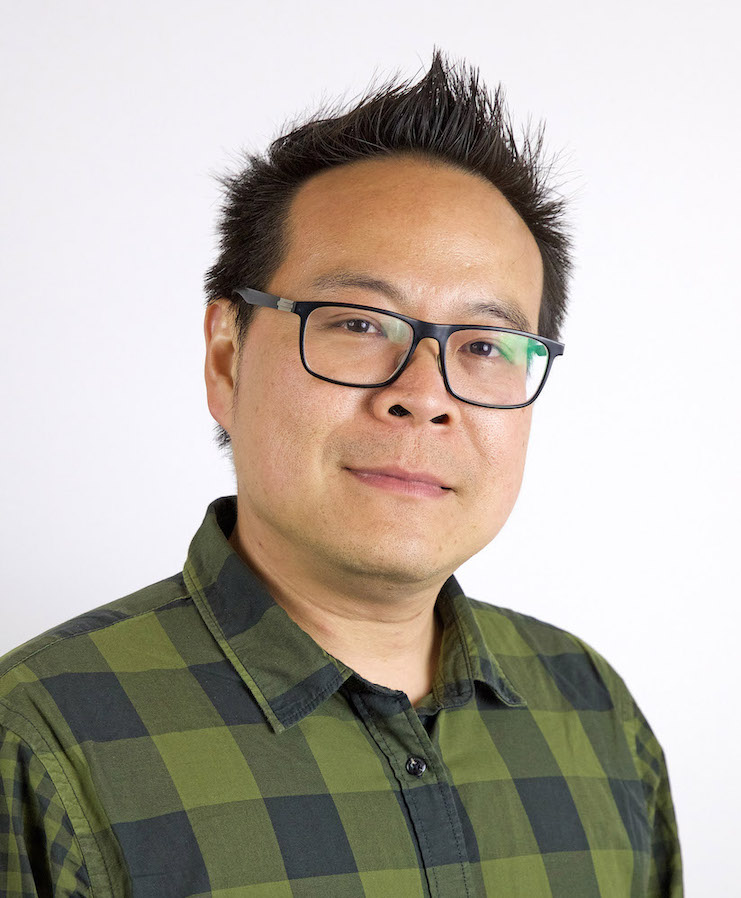
Natalia Gomez-Solano, Researcher Climate Information Services at Wageningen University | Course co-coordination
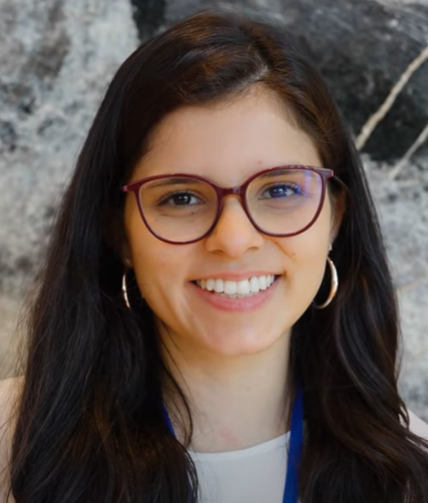
Dwaipayan Chatterjee, Scientist at KIT | Course scientific coordinator
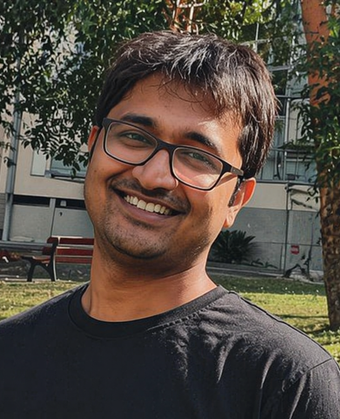
Imme Benedict, Assistant Professor in Meteorology at Wageningen University | Course developer
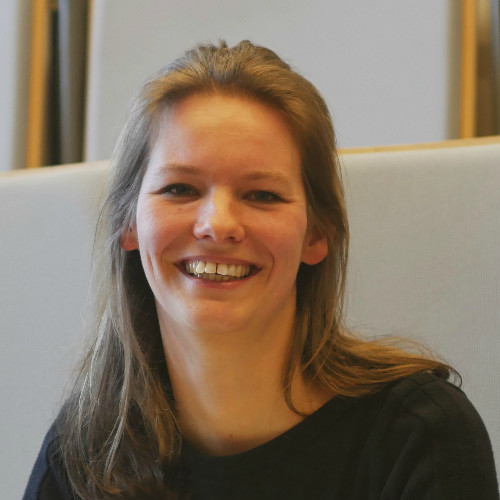
Bouke Hefting, Student Assistant at Wageningen University| Course developer
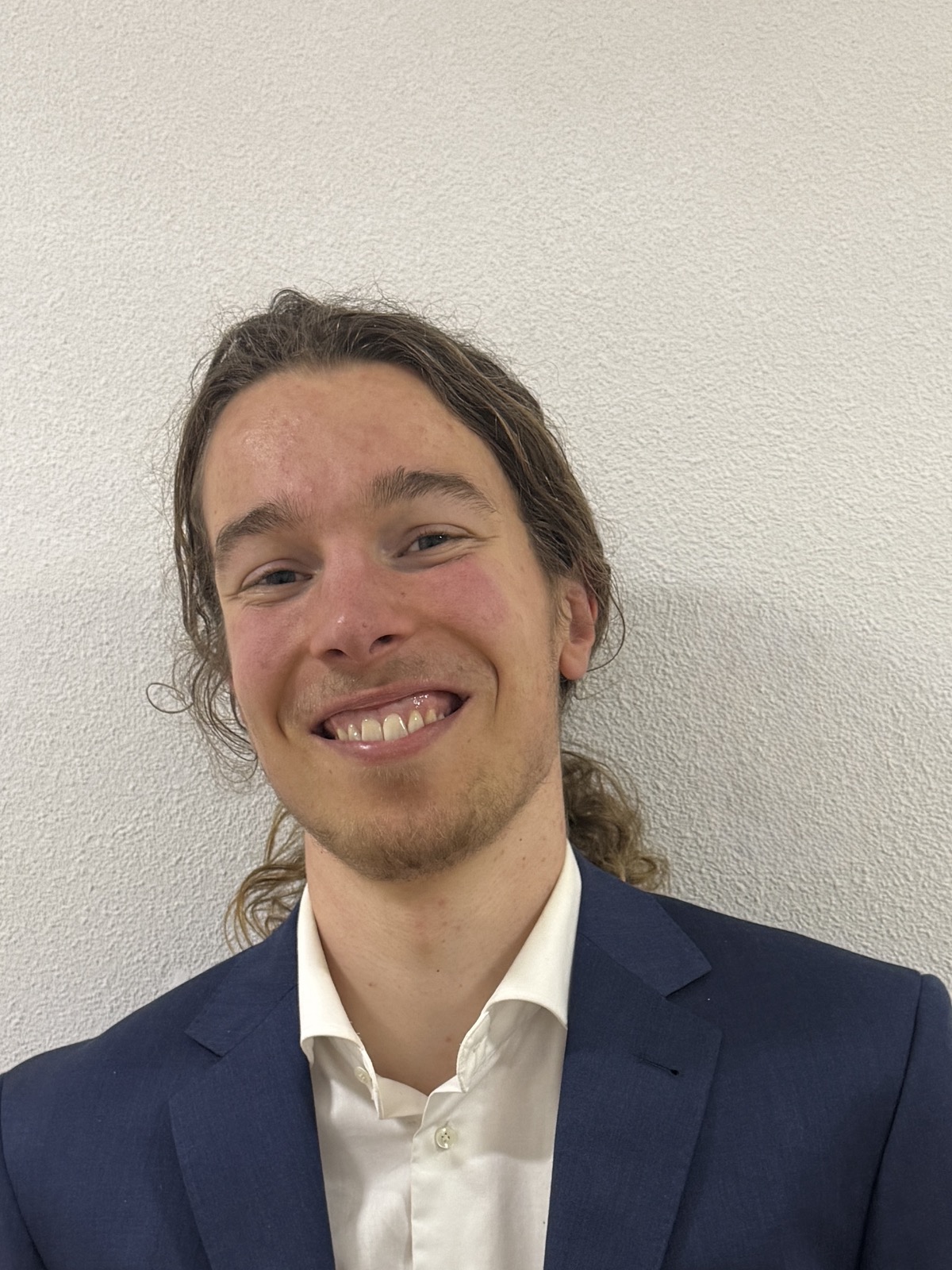
Janine Quist, Programme manager Continuing Education at Wageningen University| Educational and Communication Expert
Vassianna Alexopoulou, Online course moderator at Wageningen University| Forum Moderator
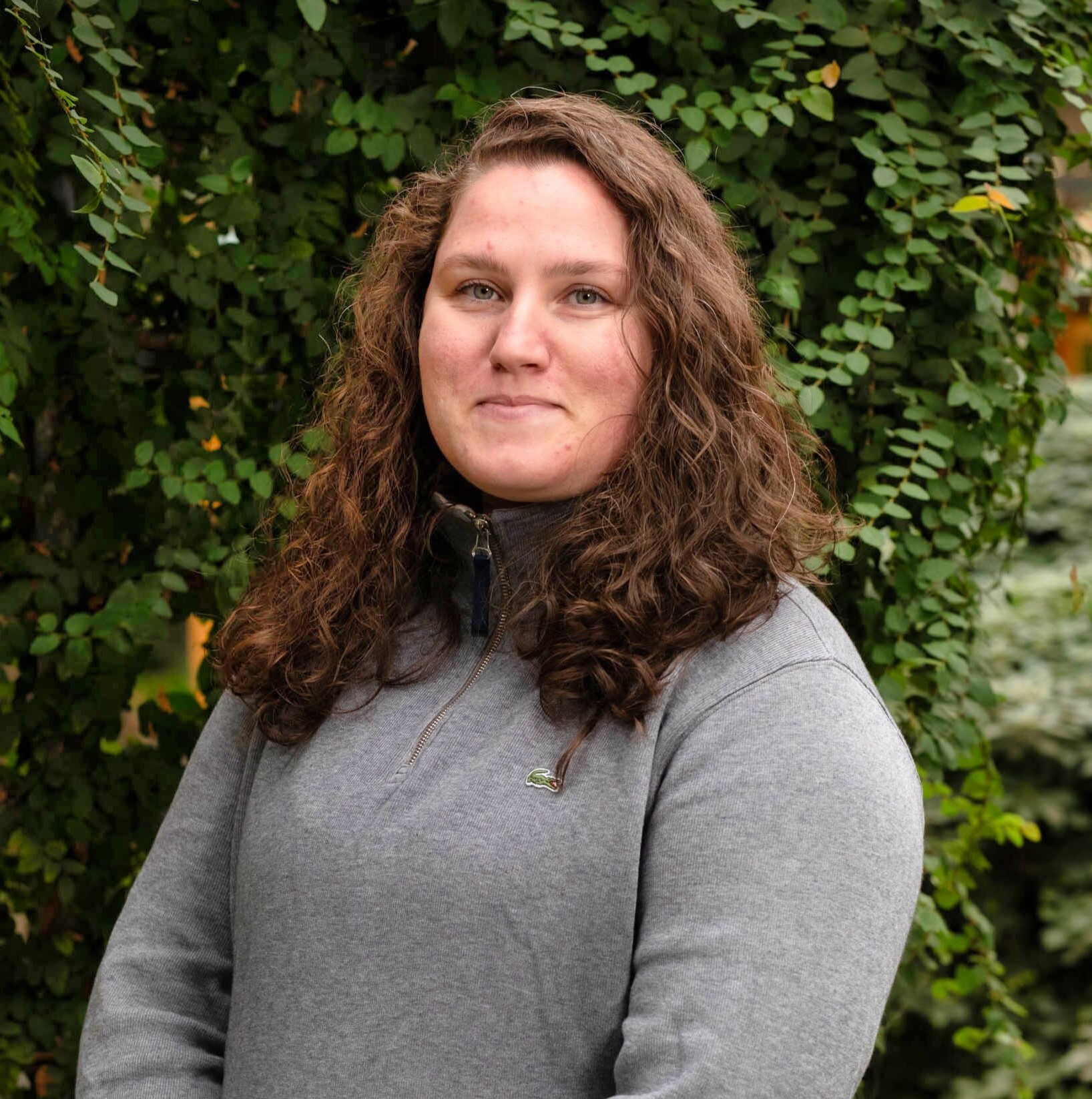
Martin Janssens, Assistant Professor in Meteorology at Wageningen University | Course developer